

Updated for February 2026
Behind every successful business is a person or team that turned an idea into reality. At the core of this kind of progression is the critical role of human resources (HR). HR drives organizational growth and innovation by utilizing effective management strategies to nurture employees.
For foreign entrepreneurs and businesses operating in Japan, understanding the Japanese HR landscape is more critical than ever. In 2026, Japan’s HR sector is undergoing significant transformation driven by major labor law reforms, rapid AI adoption, and evolving work-life balance expectations. The upcoming Labor Standards Act revisions, described as the most significant changes in 40 years, will fundamentally reshape how companies manage employees, working hours, and workplace flexibility.
This guide covers the essential aspects of HR in Japan, from traditional cultural practices to the latest 2026 legal requirements and technology trends. Whether you’re building a team from scratch or scaling operations, this comprehensive resource will help you navigate Japan’s unique HR environment successfully.
- What is the Japanese work culture like?
- What are common recruitment and hiring practices by HR in Japan?
- What role does HR in Japan play in supporting employees?
- What are some legal and social aspects of HR in Japan?
- What are some challenges for international companies regarding HR in Japan?
- Final Thoughts
What is the Japanese work culture like?
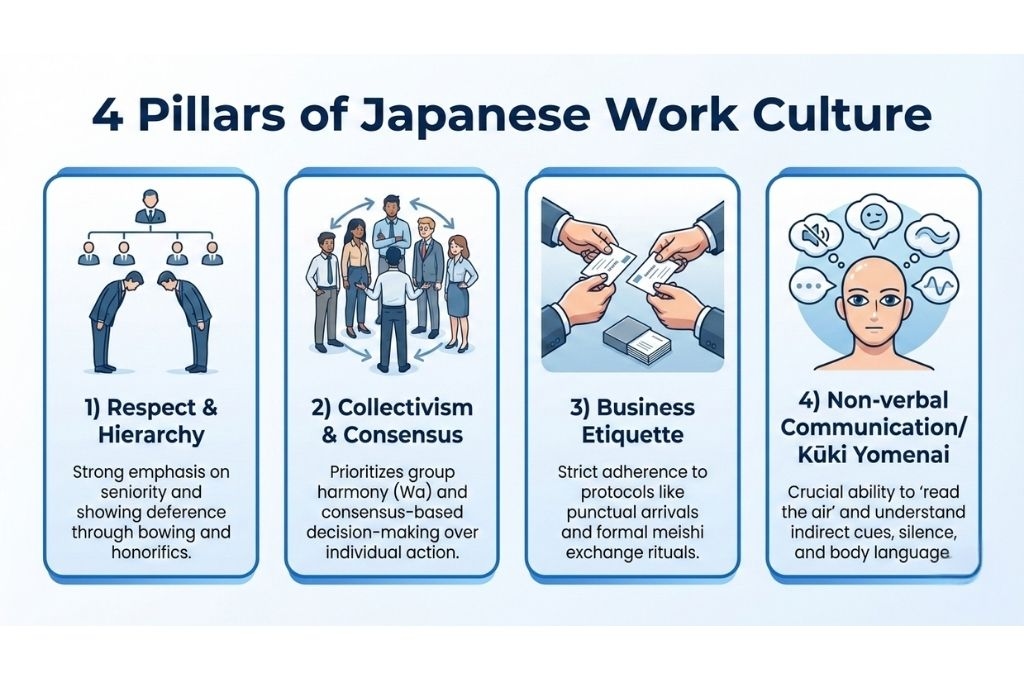
Respect and collectivism are two important traits in terms of the common Japanese work ethic and group dynamic. A typical Japanese workplace functions under a solid hierarchical structure. With this structure, it is expected of employees to understand that their seniors hold a certain degree of authority that commands formalities. So, when working in a team in the Japanese workplace, decisions are made with precision. This is done by reaching a consensus with respect to the seniors’ insights.
Business etiquette is also an important aspect of Japanese work culture. For example, Japanese employees often find themselves working overtime. This is due to the long-standing practice of staying in the office until one’s superior leaves first. However, this may change as the years go by.
Non-verbal communication plays a pivotal role in Japanese work culture as well. Understanding different non-verbal cues in Japan will contribute to an effective interaction with Japanese employees. You might encounter some cues such as kūki yomenai 空気読めない (cannot read the room). Essentially, this concept implies that not all concerns are often voiced in the workplace. To minimize conflicts in the workplace, employees tend to avoid direct confrontation. Thus, the importance of being able to read the room.
What are common recruitment and hiring practices by HR in Japan?

Hiring Practices in Japan vs. Western Standards
Shukatsu 就活 Recruitment System
A unique feature of HR in Japan is Shukatsu 就活. This applies to university students who have about one more year left before graduation. Through this system, companies and students connect and interact through seasonal recruitment cycles around winter and summer. This is different from the ad-hoc and year-round recruitment practices in the West.
Formal Interview Process
With an emphasis on respect to seniors and higher-ups, HR in Japan holds highly formal interviews. Applicants must come prepared with knowledge of interview etiquette such as business card exchanging, attire, and more. Additionally, some Japanese companies that one would find in big job-hunting events in Tokyo (e.g. Tokyo Winter Career Forum) may hold interviews on the spot! In such a case, it would be ideal for an applicant to come prepared with some prior research about the company to leave a good impression.
Internships as Recruitment Tools
Serving as a sort of extended interview process by HR in Japan, students may consider doing internships at Japanese companies where they wish to work full-time after graduation. By doing so, companies will be able to assess the student’s suitability for future employment. While this practice may also be common in the West, it might differ in terms of assessment criteria and duration.
Effective Recruitment for Foreign Businesses
Overcoming Language Barriers
Non-Japanese speaking candidates who are hoping to apply for a Japanese company might find that the language barrier could make or break some opportunities. Most of the time, if not always, Japanese companies expect a certain level of proficiency. Achieving the JLPT N3 certification is a considerable level, although N2 or N1 will open up many more doors.
However, there are also multinational companies with Japanese offices. A lot of these companies accept English as the main mode of communication in the workplace. Nevertheless, it would always help to learn a new language not only for work but to meet and get to know more people as well! If you’re looking for affordable Japanese lessons, check out Japan Switch, a Tokyo-based language school providing both lessons and self-study tips and manuals!
Attracting Top Talent in the Japanese Market
For those who are looking to become recruiters and not applicants, attracting top talent in the Japanese market in 2026 requires adapting to new expectations around AI-enhanced recruitment, hybrid work flexibility, and skill-based evaluation.
Key recruitment strategies for 2026:
First, you may want to consider participating in local recruitment events and channels such as the Tokyo Winter Career Forum, GaijinPot Expos, or connecting with agencies. Learning which ones are most popular will also help you expand your reach efficiently and meet potential recruits in large numbers.
Second, we cannot stress Japanese language proficiency enough. Showing applicants that you can ensure smooth communication is a plus point. Although many Japanese employees may turn to non-verbal cues to express how they feel about projects, it is still important to use the language to understand them better.
Third, promoting work-life balance and flexible working arrangements is now essential. Traditional companies usually have a culture of long working hours or overtime. Thus, promoting a healthier working environment with hybrid work options (combining office and remote work), flexible hours, or support for family commitments could make your company stand out. According to 2025 government surveys, hybrid work adoption has become standard, with approximately 83% of companies implementing some form of flexible work arrangement.
Fourth, leveraging AI and technology in your recruitment process demonstrates that your company is forward-thinking. Many Japanese candidates now expect companies to use modern recruitment tools, including AI-powered screening, virtual interviews, and data-driven candidate matching. However, maintain the human touch in final interviews and decision-making.
Finally, legal compliance will boost your credibility as a company. Once applicants see that your company complies with Japanese labor laws and regulations (including the upcoming 2026-2027 Labor Standards Act reforms), they may feel a sense of security in terms of employment and employee rights.
Looking to hire an accountant? Check out our case study to learn about a Japanese accounting firm that we’ve helped to scale!
What role does HR in Japan play in supporting employees?
Performance Evaluation and Development
360-degree feedback can be expected of HR in Japan. In essence, this kind of evaluation method involves receiving feedback from people in higher, equal, and lower positions. This method is an effective way to provide a diverse view of an employee’s performance by compiling perspectives from colleagues with varying expectations. Similarly, one may also expect a group evaluation to assess a team’s collective responsibility.
Although there may be an emphasis on collectivism, HR in Japan still expects employees to engage in self-assessment. This practice parallels the Japanese concept of kaizen which implies continuous improvement. By reflecting on one’s performance, they will be able to identify any points for improvement and reflect on new goals they would like to achieve.
On-the-job training (OJT) and Off-the-Job training (Off-JT) are also some training and development opportunities offered by HR in Japan. OJT is a cornerstone of training in many Japanese companies. New hires use this to their advantage to work with their colleagues, develop and enhance practical skills, and get a hang of the company culture.
On the other hand, Off-JT consists of seminars, workshops, and courses outside of the company’s regular workload. These serve as supplementary opportunities for employees to gain skills and knowledge that are not directly related to their current job responsibilities. Off-JT opportunities allow individuals to develop not only as their company’s employees but as a person in general.
Curious to learn more about unique principles such as kaizen, nemawashi, and consensus-building? Consider reading our article on Japanese Management!
Work-life balance and employee well-being
HR in Japan (or anywhere, really!) is also in charge of ensuring that employees can balance and separate their work lives from their personal lives. One way they do this is by implementing work-life balance policies.
2026 Legal Framework
HR in Japan is navigating significant regulatory changes aimed at improving work-life balance:
Upcoming Labor Standards Act Reforms (2026-2027): The Japanese government is implementing what’s being called the most significant labor law changes in 40 years. Key provisions expected to take effect include:
- Prohibition of 14+ consecutive work days without a rest day
- Mandatory rest intervals between shifts (勤務間インターバル制度 / kinmu-kan intabaru seido)
- Enhanced protections for remote and hybrid workers
- Stricter oversight of working hours for all employees, including management
Childcare/Eldercare Support (2025-2026): The revised Childcare and Family Care Leave Law (育児介護休業法) requires companies to provide at least two of five flexible working arrangements for employees with children aged 3 to school age, including telework options, flexible hours, shortened work schedules, or special childcare leave.
Customer Harassment Prevention (2026): New obligations require companies to implement measures protecting employees from customer harassment (カスタマーハラスメント / kasutama harasumento), similar to existing power harassment prevention requirements.
Health and Wellness Programs
HR in Japan is slowly making moves to increase policies that encourage a healthier balance. They monitor working hours to make sure that it complies with labor laws and address the issue of karoshi (過労死) which means death from overwork. Companies promote health benefits such as covering employees’ health insurance and offering gym programs, and recreational activities. Employees must be in a healthy physical and mental condition to work efficiently.
Furthermore, HR in Japan can also provide support for hobbies and personal development. This helps staff distinguish a healthy separation between their professional and personal lives.
Hybrid Work as Standard Practice
By 2026, hybrid work arrangements (combining office and remote work) have become the norm rather than the exception. According to Ministry of Land, Infrastructure, Transport and Tourism data, while overall telework rates have stabilized around 25%, the adoption of hybrid work models continues to expand, with most companies allowing employees to work remotely 1-4 days per week depending on role requirements.
What are some legal and social aspects of HR in Japan?
Understanding Japanese Labor Laws
Under the Japanese Constitution, hiring regulations are built upon points such as non-discrimination, employment agreements, probation periods, and mandatory social insurance enrollment. For example, it is by law that companies must not discriminate in hiring based on factors such as nationality or family origin. These points exist to uphold an employee’s rights not only as a worker but as a person as well so that all prospective workers are presented with fair opportunities.
Major 2026-2027 Labor Law Reforms
Japan is undergoing its most significant labor law transformation in approximately 40 years. While final legislation is still under review as of February 2026, HR professionals should prepare for these expected changes:
Labor Standards Act Reform (Expected 2027 Implementation)
The Labor Standards Act reforms aim to modernize workplace regulations for the digital age:
- 14-Day Consecutive Work Prohibition: Companies will be prohibited from requiring employees to work more than 13 consecutive days without a rest day
- Mandatory Rest Intervals: Introduction of required rest periods between work shifts (勤務間インターバル制度)
- Remote Work Protections: Updated regulations specifically addressing rights and working conditions for remote and hybrid workers
- Working Hour Transparency: Enhanced requirements for objective recording and management of all employee working hours, including management staff
- Side Work Overtime Calculations: Revised rules for calculating overtime when employees work multiple jobs
Social Insurance Expansion (2026-2035)
Beginning in 2026, Japan is gradually expanding mandatory social insurance coverage:
- Current (2026): Companies with 51+ employees must provide social insurance for part-time workers meeting specific criteria (weekly work hours, salary thresholds, etc.)
- July 2026: The ¥106万 annual income threshold will be eliminated within 3 years, pending minimum wage adjustments
- 2028: Expansion to companies with 10+ employees
- 2035: Universal coverage for companies with even 1 employee
Other Key Compliance Areas
Japan also has strict laws on firing regulations. The Labor Contract Act, for example, protects employees from unreasonable dismissal. Employers may only dismiss employees upon providing objectively reasonable grounds.
Additionally, employers may be put in a situation in which their company needs restructuring which could cause some employees to lose their jobs. In such a case, employers will be required to prove that the redundancy (termination of an employee’s job due to company restructuring) was necessary and that they made efforts to avoid terminations.
Disability Employment Rate Increase (July 2026)
The statutory employment rate for people with disabilities increases from 2.5% to 2.7% in July 2026. Companies with 37.5 or more employees (previously 40+) will now be required to meet this threshold.
Child/Childcare Support Fund (April 2026)
A new childcare support fund contribution begins in April 2026, added to medical insurance premiums. Estimated at ¥250-450 per person monthly, this supports government childcare initiatives.
Diversity, Inclusion, and Networking
Japan’s workforce may be historically known as a male-dominated sector, especially in senior roles. However, this is slowly changing thanks to an emphasis on gender diversity with initiatives and movements to promote women taking on leadership positions.
Additionally, Japan’s aging population implies a shrinking domestic workforce. To address this, there is now a growing trend to hire foreign individuals. Aside from bringing diversity to the workplace, this will also promote cross-cultural collaboration.
Networking will also play a big role in HR in Japan. Building relationships remains a deeply integrated part of the Japanese business culture. There are a handful of important notes about networking in Japan. For example, nomikai culture is an after-work drinking party. This takes a team out of the workplace and into an informal setting such as an izakaya to strengthen relationships and expand networks.
Another point about networking in Japan is being long-term oriented. Japanese networking is all about building long-term relationships, so it will take time to be acquainted, build trust, and collaborate. This is different from some Western networking styles which tend to be more transactional.
What are some challenges for international companies regarding HR in Japan?
Leading and Motivating Japanese Teams
As a foreigner in Japan, it may be challenging to lead and motivate a predominantly Japanese team due to cultural differences. However, this can easily be overcome by being open to learning new things and practicing respect. Japanese business etiquette plays an important role in the workplace. Foreigners who wish to work in HR in Japan should familiarize themselves with these customs and expectations.
We have also previously mentioned the idea of collectivism and teamwork in Japan. Some people might think that HR in Japan might involve individual-based evaluations. Although, teamwork is much more common. Adjusting to HR in Japan means encouraging a collaborative team environment and promoting nemawashi (根回し) which means consensus-building.
The “Management Punishment” Challenge
One of the significant HR trends in 2025-2026 is what researchers call “management role punishment” (管理職の罰ゲーム化). Middle managers in Japanese companies are experiencing increased workload and responsibility without corresponding authority increases. This creates recruitment and retention challenges for management positions. As an international company, you can differentiate yourself by:
- Clearly defining management roles and authority levels
- Providing appropriate compensation and support for managers
- Reducing administrative burden through automation and AI tools
- Offering management training and leadership development programs
Communication Challenges
Communication may be another challenge for international companies in Japan. Aside from the language barrier, Japanese employees tend to avoid direct confrontation. This may clash with individuals who come from backgrounds in which they voice out all their concerns directly. You can overcome this by learning Japanese and expressing your perspective on a situation. After some time, this practice will make employees feel comfortable enough to start doing the same.
To help you start, we have an article on Japanese business phrases, so you might want to give that a read!
Struggling to scale your business in Japan?
Technology and HR in Japan

Japan is known to be technologically advanced on a global scale. That being said, there is an increasing significance of the role of technology in HR in Japan, with 2026 marking a major turning point in how companies leverage AI and digital tools.
The AI Infrastructure Phase (2026)
Unlike 2023-2024 when companies were experimenting with AI, 2026 represents what researchers call the “AI infrastructure phase” (生成AIのインフラ化). Generative AI has moved from optional experimentation to essential business infrastructure, similar to how email and internet became indispensable tools.
Current AI Adoption in Japanese HR:
Over 90% of major Japanese companies have either used or are currently considering using generative AI for HR functions. However, implementation quality varies significantly. According to 2025-2026 surveys, approximately 49.7% of companies have established formal AI usage policies, while many others still rely on individual employee experimentation.
Common HR AI Applications in 2026:
Recruitment and Talent Acquisition: Advanced software and AI tools assist in sourcing, screening resumes (saving significant time compared to manual review), and tracking candidates through the hiring process. AI can analyze large volumes of applications to identify qualified candidates based on skills and experience patterns.
Employee Data Management: Technology manages employee data including performance evaluations, work hours, attendance records, and training history. This data helps HR make informed decisions about promotions, compensation, and development needs.
Company-Specific AI Training: The major shift in 2026 is companies moving beyond generic AI usage to training AI systems on their own internal regulations, policies, and knowledge bases. For example, HR departments are deploying internal chatbots that can answer employee questions about benefits, leave policies, and procedures based on company-specific information.
Remote/Hybrid Work Management: With collaboration, communication, and project management increasingly happening in virtual environments, Japanese companies are investing in tools that support distributed teams while maintaining productivity and connection.
Challenges and Concerns
While AI plays a critical role in optimizing certain procedures, it also comes with challenges in the context of HR in Japan. There may be concerns about:
- Privacy and Data Protection: Handling sensitive employee data requires robust security measures and compliance with Japanese privacy laws
- Cost: Initial implementation and ongoing maintenance of AI systems require significant investment
- Over-reliance Risk: Complete dependence on automated systems without human oversight can lead to poor judgment in nuanced situations
- Depersonalization: HR processes becoming too automated can damage employee relationships and trust
- Implementation Gaps: Many companies struggle to move from AI policy creation to actual effective usage across the organization
Strategic Considerations
The key question for HR in Japan in 2026 is not whether to use AI, but how to use it strategically. Companies that successfully integrate AI while maintaining the human elements of HR (relationship-building, cultural sensitivity, nuanced judgment) will gain competitive advantages in talent attraction and retention. AI should enhance rather than replace the human elements that make Japanese HR effective.
Final Thoughts
HR in Japan this 2024 may be expected to start adapting to global trends but also addressing long-standing local issues in the workplace. As we have mentioned earlier, traditional Japanese companies tend to have a culture of overtime and a historically male-dominated workforce.
However, this is slowly changing with an increase of foreign talent integrating their cultures in the workplace. This opens up new perspectives and ways of operating a company.
In summary, HR in Japan practices unique systems and principles such as shukatsu, 360-degree feedback, kaizen, and more. Compared to the West, HR in Japan has a relatively different approach to recruiting, managing, and nurturing employees.
So, if you’re ready to build your team and hire Japanese employees, we hope that you were able to consider valuable points for your business as well!
2X-5X YOUR BUSINESS IN JAPAN
Subscribe to our bi-monthly newsletter to stay updated on the latest podcast episodes, and get notified on our free monthly seminar featuring experienced entrepreneurs and experts.