

- Key Takeaways:
- Why would I want a corporate bank account in Japan?
- Who can open a corporate bank account in Japan?
- 4 Main Types of Banks in Japan
- Step-By-Step Guide to Creating A Corporate Bank Account in Japan
- Do you need a Stamp?
- How do I know which bank to apply to?
- Sumitomo Mitsui Banking Corporation (SMBC)
- Mizuho Financial Group
- Mitsubishi UFJ Financial Group (MUFG):
- Other popular banks in Japan
- Can my application for a corporate bank account in Japan be denied?
- How the October 2025 Visa Reforms Affect Your Banking Application
- Final Thoughts
Key Takeaways:
- Start with accessible banks: Online banks and shinkin offer higher approval rates for foreign-owned businesses. Build a banking history before approaching megabanks.
- Prepare comprehensive documentation: Japanese banks expect thorough documentation. Missing or incomplete documents are the most common reason for rejection.
- Address the language barrier: While some English support exists, corporate banking in Japan is fundamentally conducted in Japanese. Professional assistance can significantly improve your success rate.
- Understand the visa-banking relationship: Your visa status directly affects which banks will consider your application. The new Business Manager Visa requirements have raised the bar for everyone.
- Be patient and persistent: Multiple applications to different banks is normal. Use each interaction to learn and improve your approach.
- Consider professional support: Incorporation specialists, administrative scriveners (行政書士), and business consultants who specialize in foreign business setup can provide valuable guidance through the process.
In the business sphere, having a financial identity is essential for transactions and establishing your business, and a corporate bank account serves as the foundation of this identity. Unlike personal bank accounts, corporate bank accounts are designed to cater to the financial requirements of businesses. They typically offer a range of services uniquely designed for a businessman’s ease of use, such as payroll processing and separate employee debit/credit cards, which allow the company to pay for employee salaries and expenditures easily. Despite these benefits, opening a corporate bank account has become harder than ever.
The procedures and regulations surrounding corporate banking have become significantly stricter, particularly following major immigration reforms in October 2025. Banks now require more extensive documentation, conduct deeper due diligence interviews, and impose stricter measures requiring the CEO or representative director to be a Japanese resident. The October 2025 Business Manager Visa reforms (which increased capital requirements from ¥5 million to ¥30 million and mandated employee hiring) have made the path to corporate banking even more challenging for foreign entrepreneurs.
However, with the right knowledge and preparation, you can navigate these challenges successfully. Whether you are a seasoned entrepreneur looking to expand your ventures into the Japanese market or a budding business owner seeking to establish a financial foothold, this guide provides a step-by-step process for opening a corporate bank account in Japan, equipping you with the knowledge and insights necessary to navigate these intricate procedures with confidence.
Why would I want a corporate bank account in Japan?
Corporate bank accounts don’t sound like a must when you start, especially when the business is limited to small transactions but it’s best not to underestimate the effect having a corporate bank account has on your B2B business deals. The trust that partners and clients have in your company may also be dependent on whether or not accounts have been separated. Social credibility is low when a bank account is held by a sole proprietor as individuals are less trusted than a corporation. To better understand the social credibility each corporate structure gives you, be sure to read our article on Setting Up a Company in Japan.
Who can open a corporate bank account in Japan?
Before exploring each bank and its requirements, it’s important to understand an exclusive banking system that has become even more restrictive following recent regulatory changes. Visa requirements are clear-cut in most banks, so there is no point in applying for corporate bank accounts that don’t accept your visa type.
Visa Types Accepted for Corporate Bank Accounts
The visa types that banks typically accept fall into these categories:
| Visa Type | Japanese Term | Bank Acceptance | Notes |
|---|---|---|---|
| Permanent Resident | 永住権 | Most widely accepted | Highest approval rates |
| Business Manager | 経営・管理 | Accepted at major banks | Requirements significantly changed in October 2025 |
| Highly-Skilled Professional | 高度専門職 | Accepted at major banks | Including 高度経営・管理 category |
| Employment Visa | 就労ビザ (various types) | Limited acceptance | Depends on bank and business relationship |
| Startup Visa | 特定活動(起業準備) | Accepted at some banks | Nationwide availability from January 2025 |
| Student Visa | 留学 | Generally not accepted | Corporate accounts typically unavailable |
Critical Update: October 2025 Business Manager Visa Reforms
The Business Manager Visa (経営・管理ビザ) requirements changed dramatically on October 16, 2025. These changes directly impact your eligibility for corporate bank accounts:
New Requirements (Effective October 16, 2025):
| Requirement | Before October 2025 | After October 2025 |
|---|---|---|
| Capital Investment | ¥5 million OR 2+ employees | ¥30 million AND 1+ employee (both required) |
| Japanese Language | Not required | JLPT N2 equivalent (applicant or employee) |
| Experience/Education | Not required | 3+ years management experience OR master’s/doctoral degree |
| Business Plan Verification | Not required | Must be verified by certified professional (税理士, 中小企業診断士, or 公認会計士) |
*Existing Business Manager Visa holders have a transitional period until October 2028 for renewal applications. However, new applications must meet all new requirements. Confirm current requirements with the Immigration Services Agency or contact us.
4 Main Types of Banks in Japan
Opening a corporate bank account in Japan requires understanding the Japanese banking sector. The sector caters to different needs by offering various types of banks for individuals, businesses, and corporations. The types of banks can be categorized into four distinct groups, each with different accessibility levels for foreign-owned businesses.
Bank Type Comparison for Foreign Entrepreneurs
| Bank Type | Ease of Approval | Credibility with Partners | English Support | Best For |
|---|---|---|---|---|
| Megabanks | Most difficult | Highest | Limited | Established businesses seeking credibility |
| Local/Regional Banks | Moderate | High (regional) | Very limited | Businesses with local presence |
| Online Banks | Easiest | Moderate | Partial | Startups needing quick account access |
| Credit Unions (Shinkin) | Moderate | Good (community) | Very limited | Businesses with local community ties |
1. Megabanks (都市銀行)
Megabanks are some of the largest and most influential financial institutions in Japan. Having a corporate bank account with a megabank significantly enhances your business credibility. If a megabank approves your application, it signals that your business passed rigorous scrutiny, improving your standing with potential partners and clients who may be unfamiliar with foreign businesses.
Japan’s Three Megabanks:
- Sumitomo Mitsui Banking Corporation (SMBC / 三井住友銀行): Often considered the most accessible megabank for foreign entrepreneurs. Offers web-based corporate account applications and relatively better English documentation.
- Mizuho Financial Group (みずほ銀行): One of Japan’s largest banks with extensive international operations. Offers the M’s Salon program for startups in certain cases.
- Mitsubishi UFJ Financial Group (MUFG / 三菱UFJ銀行): The largest financial group globally by assets. Same-day walk-in applications available, but online corporate account opening is limited.
2. Local and Regional Banks (地方銀行)
Local banks operate on a regional scale, serving local communities and businesses. They can be more accessible for foreign-owned businesses with a genuine local presence.
Examples include:
- Shizuoka Bank (静岡銀行) – Shizuoka Prefecture
- Aichi Bank (愛知銀行) – Aichi Prefecture
- Hokkaido Bank (北海道銀行) – Hokkaido
- Resona Bank (りそな銀行) – Tokyo and Kansai regions
Verification note: Acceptance criteria vary significantly by branch and region. Building a relationship with your local branch before applying can improve success rates.
3. Online Banks (ネット銀行)
Online banks have gained significant popularity and are often the most accessible option for foreign-owned businesses. While they may offer less credibility with traditional Japanese business partners, they provide convenient digital banking solutions.
Key online banks for corporate accounts:
- Rakuten Bank (楽天銀行): Japan’s largest online bank with over 17 million accounts (as of 2025). Offers partial English interface and lower fees. Note: Corporate applications are generally processed in Japanese.
- PayPay Bank (PayPay銀行): Digital-first bank offering easy online account opening and integration with PayPay payment system. Domestic-focused with limited international transfer options.
- SBI Sumishin Net Bank (住信SBIネット銀行): Known for startup-friendly policies and easier approval processes for foreign-owned businesses.
- GMO Aozora Net Bank (GMOあおぞらネット銀行): Offers corporate accounts with relatively streamlined application processes.
Verification note: Online banks generally don’t handle foreign exchange or international remittance services. If your business requires frequent international transactions, consider combining an online bank account with a megabank account or a service like Wise Business.
4. Credit Unions (信用金庫)
Credit unions focus on cooperative financial services for their members, often based on geographic or industry affiliations. They can be surprisingly accessible for foreign entrepreneurs with genuine local business activities.
Examples include:
- Joyo Bank (常陽銀行) – Ibaraki region
- Dai-ichi Kangyo Credit Union
- Various regional shinkin banks
Credit unions prioritize community relationships, so demonstrating commitment to the local area can be advantageous.
We Handle Your Corporate Bank Account Setup End to End
- Bank selection matched to your visa and business type.
- Documentation prepared in proper Japanese format.
- Trusted by 100+ companies incorporated across Japan.
via SmartStart Japan
Book a Free ConsultationSimplified Banking Solutions for Your Business
Expert Support for Your Banking Journey
Navigating the intricacies of opening a corporate bank account in Japan requires precision, patience, and a clear understanding of the process (especially following the October 2025 visa and regulatory changes). Working with experienced partners can significantly improve your success rate.
Professional support can help you:
- Prepare documentation in proper Japanese format
- Understand which banks are most likely to approve your specific business type
- Navigate the interview process, which is typically conducted in Japanese
- Ensure your business plan meets current regulatory standards
- Coordinate timing between company registration, visa status, and bank applications
The corporate bank account is one piece of a larger puzzle that includes company incorporation, visa status, office setup, and ongoing compliance. Coordinating these elements properly can mean the difference between approval and rejection.
SmartStart Japan’s team handles everything from preparing necessary documentation to liaising with banks on your behalf, ensuring nothing is overlooked. Their insider knowledge means they can guide you through selecting the right bank for your business; one that aligns with your industry, financial needs, and long-term goals.
With SmartStart Japan by your side, you gain not just efficiency but peace of mind, knowing your corporate account setup is in expert hands. Contact SmartStart Japan today.
Step-By-Step Guide to Creating A Corporate Bank Account in Japan
Securing a corporate bank account in Japan involves more than filling out an application form. It requires thorough preparation, the right documentation, and often, multiple application attempts. Below is the general process, though specific requirements vary by bank. Please note that these steps are not exact and you should refer to the bank’s website for the most accurate application process.
Step 1: Prepare Required Documents
Core Documents (Required by All Banks):
| Document | Japanese Name | Notes |
|---|---|---|
| Certificate of Registered Matters | 履歴事項全部証明書 | Must be issued within 6 months (some banks require 3 months) |
| Articles of Incorporation | 定款 | Certified copy from Legal Affairs Bureau |
| Certificate of Corporate Seal | 印鑑証明書 | Must be issued within 6 months |
| Corporate Seal | 会社印(法人印) | For documents and transactions |
| Tax Office Notification | 法人設立届出書の控え | Copy of filing receipt |
| Representative’s ID | 本人確認書類 | Residence card + passport for foreign representatives |
Additional Documents (Often Required):
| Document | Japanese Name | When Required |
|---|---|---|
| Business Plan | 事業計画書 | New companies, especially with foreign ownership |
| Office Lease Agreement | 賃貸借契約書 | Proof of legitimate business premises |
| Company Website or Brochure | 会社案内・ウェブサイト | Demonstrates business legitimacy |
| Existing Contracts | 契約書・見積書・請求書 | Proof of actual business activity |
| Sublease Agreement | 転貸借契約書 | If office is subleased |
| Power of Attorney | 委任状 | If someone other than representative applies |
| Business License | 許認可証 | For regulated industries (restaurants, travel, etc.) |
*Document requirements vary significantly by bank. Contact your target bank for their specific current requirements before applying.
The Document List Is Long. We Know Exactly What Banks Want.
- All documents prepared in Japanese, core and supplementary. Nothing missing.
- Business plan structured to meet AML and KYC standards. Reviewed before submission.
- Trusted by 100+ companies incorporated across Japan.
via SmartStart Japan
Start Your ApplicationStep 2: Choose Your Target Bank Strategically
The order in which you apply matters. Consider this strategic approach:
Recommended Application Order for Foreign-Owned Businesses:
- Start with online banks (highest approval rates)
- Try local shinkin banks near your office
- Apply to Japan Post Bank (ゆうちょ銀行)
- Attempt regional banks
- Finally, approach megabanks (most difficult but highest credibility)
Tip: Don’t apply to multiple banks simultaneously in the early stages. A rejection at one bank doesn’t automatically disqualify you elsewhere, but having an approved account from even an online bank can improve your chances at traditional banks later.
Step 3: Make an Appointment
- Contact the bank to schedule an appointment (予約) for corporate account opening
- Web-based pre-registration is available at SMBC, Mizuho, and some regional banks
- Bring all documents to the appointment—missing documents often result in rejection
Step 4: Attend the Interview
The bank interview (面接) is critical and typically conducted in Japanese:
What to Expect:
- Questions about your business model and revenue sources
- Inquiry about why you chose Japan as your business location
- Questions about your transaction patterns (incoming/outgoing funds)
- Verification of your office location and business activities
- Assessment of your (or your representative’s) Japanese language ability
Preparation Tips:
- Practice explaining your business in simple Japanese
- Bring a Japanese-speaking colleague or professional if possible
- Have business cards and marketing materials ready
- Be prepared to explain your connection to Japan and long-term plans
Step 5: Verification and Approval
After the interview, the bank conducts due diligence:
Typical Timeline:
| Bank Type | Typical Processing Time |
|---|---|
| Online Banks | 1-2 weeks |
| Shinkin/Regional Banks | 2-3 weeks |
| Japan Post Bank | 2-4 weeks |
| Megabanks | 3-6 weeks |
During this period, the bank may:
- Visit your office to verify your business premises
- Request additional documentation
- Conduct background checks on the company and representatives
- Contact you with follow-up questions
Step 6: Receive Account Details
Upon approval, you’ll receive:
- Account number (口座番号)
- Online banking credentials (if applicable)
- Corporate debit/credit card (if requested)
- Cash card and bankbook (通帳) > though some banks are moving to passbook-free accounts

Do you need a Stamp?
Yes, you typically need corporate seals (stamps) to open a corporate bank account in Japan. Despite ongoing government efforts to reduce hanko requirements, they remain essential for most banking procedures.
Types of Corporate Seals Required
| Seal Type | Japanese Name | Purpose | Registration Required |
|---|---|---|---|
| Representative Director’s Seal | 代表取締役印 (実印) | Official company seal registered with Legal Affairs Bureau | Yes – with 法務局 |
| Bank Seal | 銀行印 | Specifically for banking transactions | No (but must match bank records) |
| Company Seal | 社印 | General business documents | No |
| Personal Seal | 個人実印 | Representative’s personal seal | Yes – with ward office |
Seal Registration Certificate (印鑑証明書)
The Seal Registration Certificate is a crucial legal document that certifies the authenticity of your registered seal. For corporate bank account opening, you’ll need:
Corporate Seal Certificate (法人の印鑑証明書):
- Obtained from the Legal Affairs Bureau (法務局)
- Usually must be issued within 6 months (some banks require 3 months)
- Available via online request if you have a seal card (印鑑カード)
- Fee: ¥450 per certificate
Personal Seal Certificate (for representative):
- Obtained from your ward/city office (区役所/市役所)
- Can be obtained at convenience store kiosks with My Number Card
- Fee: ¥300-450 per certificate (varies by municipality)
Seal Size Requirements
| Requirement | Specification |
|---|---|
| Outer dimension | 8mm – 25mm |
| Shape | Must have clear outer border |
| Content | Cannot use nicknames |
| Material | No restrictions (common: wood, titanium, buffalo horn) |
Note that some banks are beginning to accept signature-based accounts (サイン式), particularly for foreign nationals. Confirm with your target bank whether seal-free options are available for corporate accounts.

Do I need to speak Japanese?
English banking in Japan is limited and not recommended. While SMBC is well-known for better English service than the rest, this service is not included in applying for a corporate bank account in Japan. Translators may or may not be rejected so it’s best not to take the chance. Additionally, all applications must be filled in Japanese.

What are AML and KYC?
In Japan, banks strictly adhere to Anti-Money Laundering (AML) and Know Your Customer (KYC) regulations. To comply, businesses are required to provide essential documentation and information that have been listed above and below. Japanese banks have robust AML and KYC procedures, including customer identification and monitoring for suspicious activities. Businesses must provide information about their identities, ownership, and operations, along with documentation to verify beneficial owners, funds’ sources, and transaction purposes. This approach ensures transparency and aligns with Japan’s commitment to combat money laundering and terrorism financing.
How do I know which bank to apply to?
Choosing a bank to open a corporate bank account in Japan with is a daunting task. With a diverse array of banks and financial institutions available, making an informed decision requires careful consideration of your business’s requirements and preferences. For personal guidance, listen to our podcast on Banking and Loans in Japan with Larry Greenberg, CEO of Urban Connections, where he gives his own personal bank recommendations in Japan.
Think you’re ready to open a corporate bank account in Japan? To help you with which bank to choose, we’ve compiled a list of pros and cons for the big three banks along with their requirements and application procedures so you can see which ones meet your needs. Afterward, you will find some general information on other popular banks in Japan.
Sumitomo Mitsui Banking Corporation (SMBC)
SMBC is often considered the most accessible of the three megabanks for foreign entrepreneurs. They have relatively better English documentation and offer web-based corporate account applications.
Requirements
| Document | Notes |
|---|---|
| Seal Registration Certificate | 印鑑証明書 – within 6 months |
| Certificate of All Historical Matters | 履歴事項全部証明書 – within 6 months |
| Office Lease Agreement | 賃貸借契約書 for main office |
| ID of Account Opener | Residence card + passport for foreigners |
| Building Registration or Lease | 建物謄本 or 賃貸借契約書 (required for web applications) |
| Sublease Agreement | If tenant differs from company |
| Power of Attorney | 委任状 if not representative |
| Business License | For regulated industries |
Pros
- Cheapest online banking service
- Support for opening corporate bank accounts for business entities of non-Japanese corporations in Japan
- Flexible online banking with numerous options
Cons
- Hefty documentation requirements
- Long wait times
Other key points
- Minimum Wait Time: 1 month approximately after submission of documents
- What you can avail with the Corporate Bank Account in Japan:
- Corporate credit card
- Free sending and receiving payments internationally (Global e-Trade)
Application procedure
Applying to SMBC for a corporate bank account in Japan is divided into two separate flows depending on whether you apply online or offline. The table below outlines who can apply for each application type to guide you on which would best suit you based on your status.
| Application type | When opening a corporate account online | Status required |
| Online applications | Web-only application | Customers whose legal entity is a corporationCustomers whose business is other than investment business, financial business, or special purpose company Customers whose representative is the person completing the procedure on the web (*1) Customers who can receive mailed documents at the address (*2) of the certified copy ( certificate of all history items or Rireki Jikou Zenbu Shomeisho or 履歴事項全部証明書) (forwarding is not possible) |
| Pre-registration online and then complete at the bank | Customers with a corporate status labeled as “Limited,” “Joint Venture,” “Joint Name,” or “Limited Partnership Company.”Customers whose primary business falls within the categories of investment business, financial business, or special purpose companies.Customers whose designated agent is the individual responsible for completing the online procedure.Customers whose address on the certified copy (certificate of complete history) lacks a room number and building name.Customers utilizing virtual office spaces. | |
| In-bank applications | Individual business ownersCustomers of associations/foundations without juridical status (associations, industry groups, circles, etc.)Customers who are foreign corporations, national/local governments, or independent administrative institutions Customers who cannot apply using a computer | |
(*1)When opening a corporate account online, you will need to verify your identity using a smartphone camera and upload various documents. Please note that if the uploaded image is unclear, you may need to visit our store.
(*2)We will mail the documents you need to start using the service to the address listed by “simple registered mail” with no forwarding required. Please note that if the room number or building name is not listed, or if it is a virtual office, etc., it will not be eligible for online completion.
The following flowchart gives you a visual on how to apply for a corporate bank account in Japan through the web. Note that for in-bank applications, the bank only requires you to go to the nearest bank to your office and bring your requirements.
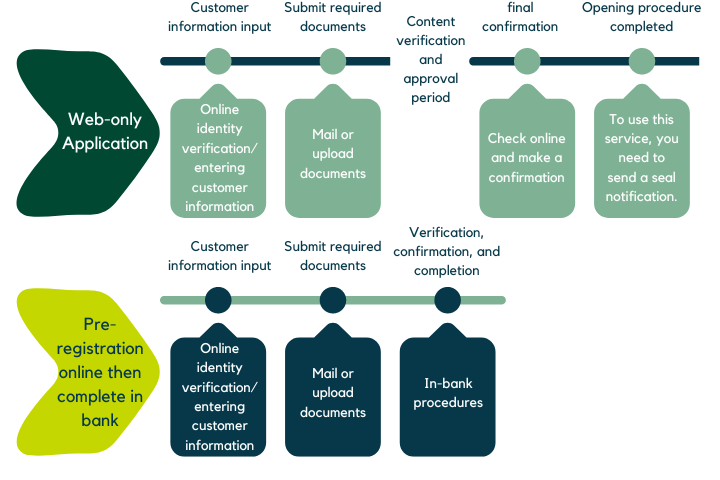
Regarding submitting required documents for a corporate bank account in Japan, please prepare a PDF file when uploading, a copy when mailing, and the original when visiting a store.
Mizuho Financial Group
Requirements
- Certificate of all Historical matters (Rireki Jikou Zenbu Shomeisho or 履歴事項全部証明書)
- Presentation of the tōkibotōhon during the interview (notarized registration documents)
- Submission of ID or document from the representative and/or interviewee that can confirm the name, address, date of birth, etc. of the representative, corporate seal (if applying in-bank)
- Visa Status Required: Business Manager Visa
Pros
- Mizuho offers the cheapest option for making transfers through online banking.
Cons
- Mizuho has the most expensive monthly fee for online banking
- They do not have a dedicated mobile app, and their online banking service is limited
- The online system is known for being unreliablePlease note the rules or offer may have changed but here is the link.
Other key points
- Minimum Wait Time: 1 week from the initial interview
- What you can avail with the Corporate Bank Account in Japan:
- Corporate Credit Card
- Mizuho’s internet banking service
Application procedure
Mizuho Bank allows you to apply for opening a corporate bank account in Japan either online or in-bank. For a list of compatible bank branches for opening a corporate bank account online, check this list of branches.
Applying to Mizuho for a corporate bank account in Japan is divided into two separate flows depending on whether you apply online or offline. The table below outlines who can apply for each application type to guide you on which would best suit you based on your status.
| Application type | Status required |
| Online applications | Anyone except the following: Customers whose country of establishment (head office location) stated on the registration certificate is other than JapanCustomers whose industry is a financial institutionCustomers whose main business purpose is investment management An unlisted company whose investment income ratio is 50% or more of the total income in the previous business year, or whose assets generate investment income is 50% % or more of business entities Newly established customers whose tax residence country of the beneficial controller is other than Japan and there is no immediately preceding business year (Check this list for confirmation of beneficial controller) |
| In-bank applications | Sole proprietors and (optional) group customers Customers who wish to open an account other than a savings account Customers who already have a corporate account with Mizuho BankCustomers who wish to apply and have an interview at a store Customers whose registered head office location (country of establishment) is outside of Japan |
The following flowchart gives you a visual on how to apply for a corporate bank account in Japan through the web. Note that for in-bank applications, the bank only requires you to go to the nearest bank to your office and bring your requirements.
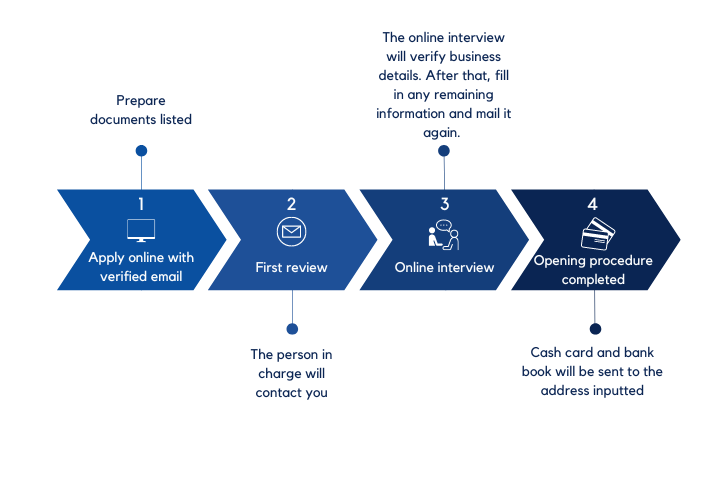
As a note, applying online requires you to apply for Mizuho Business WEB, Mizuho Web Form Service, and Mizuho Business Debit altogether as one.
Mitsubishi UFJ Financial Group (MUFG):
Requirements
- Seal Registration Certificate
- Certificate of all Historical matters (Rireki Jikou Zenbu Shomeisho or 履歴事項全部証明書)
- ID for the company representative and interviewee (if separate people)
- Interview with a bank employee (after the application)
- Visa Status Required: Business Manager Visa
Pros
- Cheapest online banking service
- Support for opening corporate bank accounts for business entities of non-Japanese corporations in Japan
- Same-day walk-in applications are allowed
- The online interview process is relatively straightforward and quick to arrange
Cons
- Inflexible online banking with fewer options than competitors
- Long wait times (at least a month for opening a corporate bank account)
- BizStation has set processing times, with no payments processed between midnight and 8:00 a.m., and transfers after 3:00 p.m.
- Fees for transfers are fixed, which may not be cost-effective for certain transaction sizes
- The interface of the online banking platform is considered extremely outdated when accessed via a web browser
Other key points
- Maximum Wait Time: 4 weeks (From application to completion)
- What you can avail:
- Corporate credit card
- Free sending and receiving payments internationally (Global e-Trade)
Application procedure
Applying to MUFJ for a corporate bank account in Japan divides its applicants into whether they’re up for the challenge of opening up a domestic business or not. The flow chart below outlines who can apply for each application type to guide you on which would best suit you based on your status.
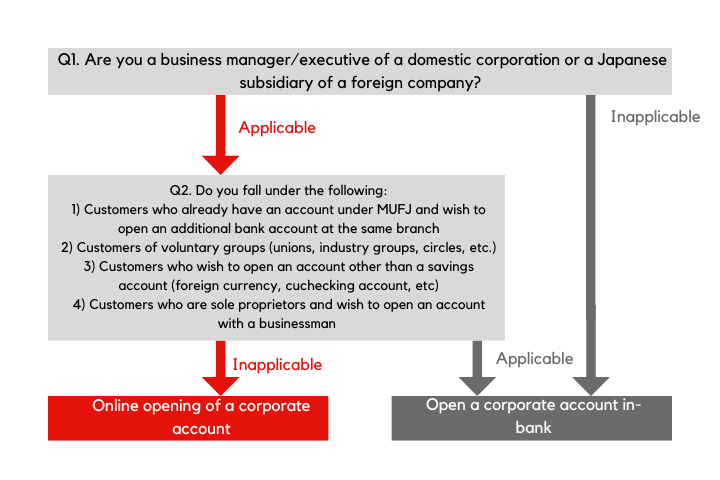
MUFJ Bank allows you to apply for opening a corporate bank account either online or in-bank. However, some banks only allow in-bank procedures. We strongly recommend navigating the MUFJ Bank website for lists of bank branches that are compatible with your preferred procedure.
The following flowchart gives you a visual on how to apply through the web. Note that for in-bank applications, the bank only requires you to go to the nearest bank to your office and bring your requirements.
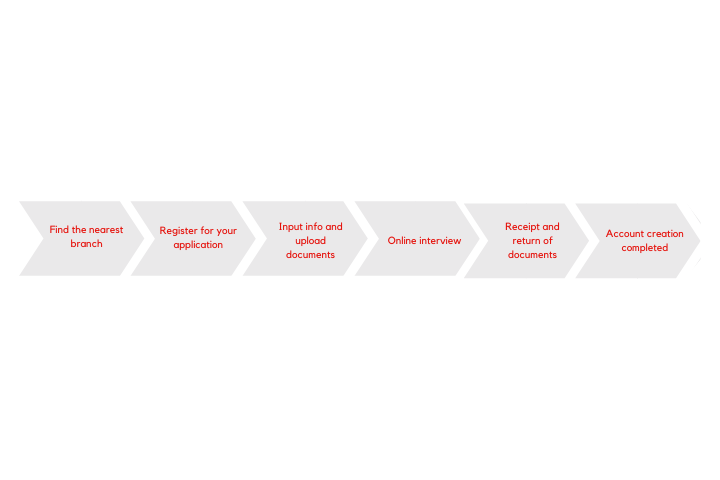
These three banks have the best outlines in the banking industry for the corporate bank account in Japan niche but how do you get a bank account if you aren’t in Japan? A few business processing outsourcing companies actually offer this service and we are in touch with some that can help create SMBC accounts. Contact Scaling Your Company to get in touch with these companies if you’re serious about entering the Japanese market and willing to pay medium-tier rates (100,000 yen+ monthly).
Otherwise, the big three banks offer startup accelerators that may allow you to apply after the program. One known example is Mizuho. The rules may have changed or may change over time but look out for these opportunities. To learn more about startup accelerators, be sure to read through our article on Top 10 Start-up Accelerators in Japan.
Other popular banks in Japan
Resona Bank
- Requirements: Seal Registration Certificate, Certificate of All Historical matters (Rireki Jikou Zenbu Shomeisho or 履歴事項全部証明書) dated within three months (shorter than the usual six months), Two pieces of identification for the representative opening the account, Lease agreement for the main business premises
- Visa Status Required: Business Manager Visa
- Minimum Wait Time: 10 days
- Pros:
- Well-located for businesses in major metropolitan areas.
- The app and well-designed online banking service allow for streamlined financial management.
- Cons:
- Requires more documentation compared to most other banks, resulting in a paperwork-heavy application process.
- The online banking service is relatively expensive, which may not be economical for smaller businesses.
Japan Post Bank
- Requirements: Paper-Based Application Form, Original Registration Documents, Two Pieces of ID, Corporate Number, original certificate of Seal Registration (Rireki Jikou Zenbu Shomeisho or 履歴事項全部証明書), a list of company officials, balance and income sheets, a lease for your main business premises, and a copy of the Representative Director’s residence card (if they are not a Japanese national)
- Visa Status Required: Employment Visa
- Minimum Wait Time: 4 weeks
- Pros:
- Low transfer fees with the online banking service (Yucho Biz Direct).
- High level of scrutiny during account opening, resulting in a very low rejection rate.
- Relatively affordable monthly fees for online banking.
- Cons:
- The application process is inefficient and laborious, involving extensive documentation.
- The online banking system is considered archaic and may not offer the same level of modern features and convenience as some competitors.
Can my application for a corporate bank account in Japan be denied?
Short answer: Yes
Long answer: In an article by the official Kobe City website, we learn three main reasons behind denied applications for a corporate bank account in Japan. Banks take tight measures in seeking a company’s legitimacy. This can be done by taking a look at three factors.
| Reason | Explanation | How to Address |
|---|---|---|
| Insufficient Capital | Capital too small for stated business activities | Ensure capital aligns with business plan |
| No Physical Office | Virtual office or co-working space | Obtain dedicated office with proper lease |
| Unclear Business Model | Bank cannot understand how you’ll make money | Prepare clear business plan in Japanese |
| Short Visa Duration | Remaining visa period under 3-6 months | Renew visa before applying |
| No Business Activity Proof | No contracts, invoices, or website | Develop business presence before applying |
| Misaligned Business Purpose | Activities don’t match stated purpose | Ensure consistency across all documents |
| AML/KYC Concerns | Unusual transaction patterns or high-risk indicators | Be transparent about fund sources |
| Language Barrier | Unable to communicate during interview | Bring qualified interpreter or Japanese-speaking staff |
Most Bank Account Rejections Come Down to Preparation
- Business model and documents reviewed before submission.
- Interview preparation included
- Trusted by 100+ companies incorporated across Japan.
via SmartStart Japan
Avoid the RejectionHow the October 2025 Visa Reforms Affect Your Banking Application
The Business Manager Visa reforms that took effect on October 16, 2025, have significant implications for corporate bank account applications.
Direct Impacts on Banking
Capital Verification: Banks have always verified that your business has adequate capital. With the new ¥30 million requirement for Business Manager Visa, banks may now expect to see substantially higher capitalization, even if they don’t explicitly require this amount.
Employee Verification: The new requirement for at least one full-time employee means banks may ask for:
- Employee contracts
- Social insurance enrollment proof
- Payroll documentation
Japanese Language Documentation: With the new JLPT N2 requirement (for either applicant or employee), banks may have increased confidence in your ability to manage Japanese-language banking operations.
Professional Business Plan Verification: Since visa applications now require business plan verification by certified professionals (税理士, 中小企業診断士, 公認会計士), banks may request a copy of this verified plan.
Timeline Considerations
If you’re applying for both a Business Manager Visa and a corporate bank account, consider this typical sequence:
- Before Entry: Prepare capital, business plan, identify office space
- Entry on Startup Visa: Open personal account, transfer capital
- Company Registration: Register with Legal Affairs Bureau
- Corporate Bank Account: Apply with registered company documents
- Business Manager Visa: Apply with bank account and other requirements
*The interplay between visa requirements and bank requirements continues to evolve. Work with immigration and corporate specialists who understand both systems. Contact a service like Smartstart Japan to get tailored advice for your situation.
Final Thoughts
In the realm of Japanese corporate banking, thorough knowledge and meticulous preparation are your best allies. A corporate bank account in Japan is the foundation of your financial identity as a business, offering tailored services crucial for managing transactions, salaries, and credibility with partners and clients. Choosing the right bank in this case is like picking which battles you’d like to fight with all the pros and cons of each one. Most people, though, would recommend SMBC to start out, because of the more relaxed Visa requirements. With any choice, you’re bound to run through problems if you don’t prepare so start collecting your documents and ensure your business is well-equipped for success in Japan’s financial landscape.
2X-5X YOUR BUSINESS IN JAPAN
Subscribe to our bi-monthly newsletter to stay updated on the latest podcast episodes, and get notified on our free monthly seminar featuring experienced entrepreneurs and experts.