Japan’s fascinating high level of business professionalism and quality customer service, as well as giving importance to appearance, are recognized around the world. So, assumptions from foreign business professionals, such as having an aesthetically amazing Japanese office to meet such high expectations from potential Japanese clients, are not a surprise.
Many foreigners think that having a dedicated office can be crucial for foreign companies trying to create a physical presence in Japan. That may be true to some extent. A dedicated office gives your staff a professional work environment and can raise your reputation in the neighborhood. However, a Japanese office can be quite expensive, especially in the middle of Tokyo. It will definitely require extra expenditures for staffing, infrastructure, and legal compliance.
In this article, we will provide some alternative options for a workspace and cover the merits and demerits of renting a Japanese office, so you can make an informed decision when doing a Japan market entry.
First of all, why would you need a Japanese office?
Having your own dedicated space to work in and meet potential clients or business partners in projects has a certain air of professionalism. It builds trust and makes you appear more legitimate as a business person. It can also give your company a physical presence in the local community if you are in a smaller city or town, and a more formal meeting venue with clients or business partners, especially for enterprise clients or more traditional companies.
Not only that, but having your own office is a requirement for getting a business manager visa in Japan and for creating a corporate bank account. Additionally, you need a bank account to receive subsidies and loans as well. Depending on the type of work you do, if a license is needed, you will most likely need a private Japanese office to be eligible for the license. comes in.
Do you need a dedicated office?
First off, it’s important to understand the way business works in Japan. Assuming you’re a startup or a business person just starting, you probably won’t be able to secure a premium Japanese office in an expensive location (nor should you try, as it probably won’t be worth the cost).
As such, it’s unlikely that your prospective clients or partners will be impressed by your office, and it can negatively affect your sales in Japan. This is because business in Japan works on a hierarchical system. This means you can use the good old tactic of always making sure to visit the client, as opposed to them visiting your office
For one, it eliminates the need to hold your own dedicated office in a fancy part of town.
Secondly, it keeps potential clients comfortable and might predispose them towards doing business with you. It shows them that you respect their time and place them as higher than you in the hierarchy, and that’s one of the biggest compliments you can pay a business person.
Of course, you do need a physical office for some aspects of your business, such as incorporation and getting a corporate bank account. You need to have your address on your homepage’s about page for everyone doing B2B in Japan (we can help you make a fully localized website). Fortunately, though, you can do that while using a shared office. This could give you the prestige and benefits of a physical office while reducing the downsides. A co-working space won’t end up costing you as much, and may even allow you to score a working space in a better, more prestigious location than getting your own Japanese office.
Alternatively, virtual offices in Japan are another cost-effective way to incorporate your company in Japan without the high overhead costs that come with office leases. So, if you’re still in the beginning stages of your startup journey, So, should you get a dedicated Japanese office? Eventually, yes. A dedicated office might perk up your company’s standing on the Japanese business scene. However, when you’re just starting as a businesswoman, renting a co-working space might end up being a better, more cost-effective idea. There are lots of co-working and shared office spaces in Japan that will surely offer a more adaptable and affordable choice for companies wishing to establish a presence in the country.
Types of Japanese offices
Regardless if you’re working solo or operating within a larger company, you should become acquainted with the different types of Japanese offices available. (We also talk about the different types of leases available below.) Before you decide on which sounds like the best choice for you, it’d be wise to consider what type of rental you’re looking for.
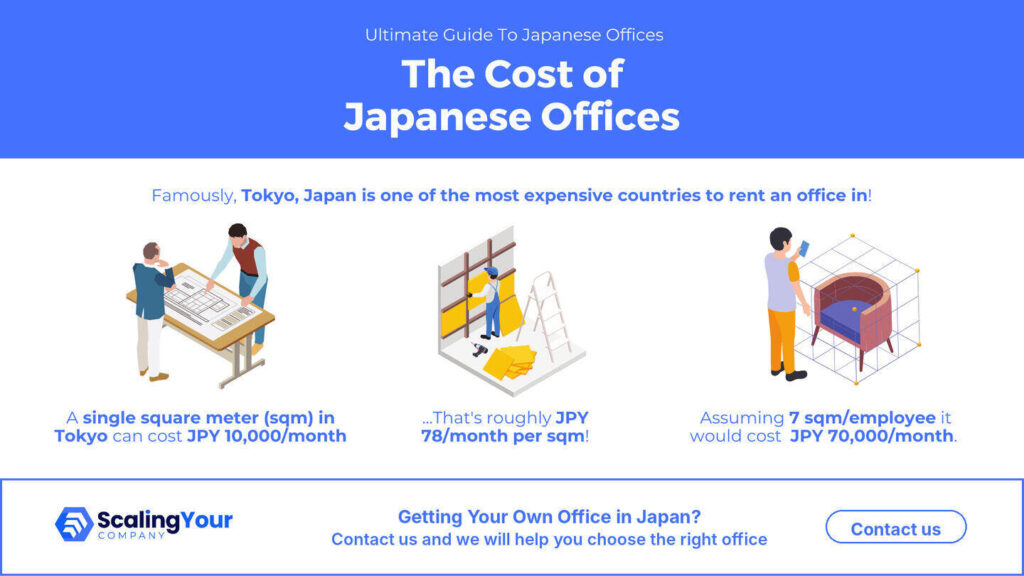
Famously, Japan is one of the most expensive countries to rent an office in. Reportedly, a single square meter can cost upward of ¥ 10,000 per month. That’s roughly $78 per square meter. So choosing to rent and design your own office can end up costing you a lot of money. Assuming you’re allocating about 7 square meters per desk, per employee, that could run you up to ¥ 70,000, or roughly $550.
Fortunately, Japan also has this nifty renting option called a “serviced office”. Basically, as the name suggests, these are already furnished offices that you get to rent in different sizes (depending on your necessities). As a solo entrepreneur or a new company, you may want to rent a single office space and upgrade as you grow the company, while a later-stage startup or multinational company may find it useful to rent an entire serviced office floor (which would enable them to access meeting areas, a reception desk, etc.).
The main benefit of renting a serviced office is that you no longer have to bother about furnishing the space. You’re also able to start using them immediately, as serviced offices are already equipped with furniture, IT infrastructure, office equipment, and so on. Places like WeWork also offer an amazing atmosphere for networking, and several of my B2B clients have regularly found customers or sales partners at WeWork.
Types of Japanese office leases
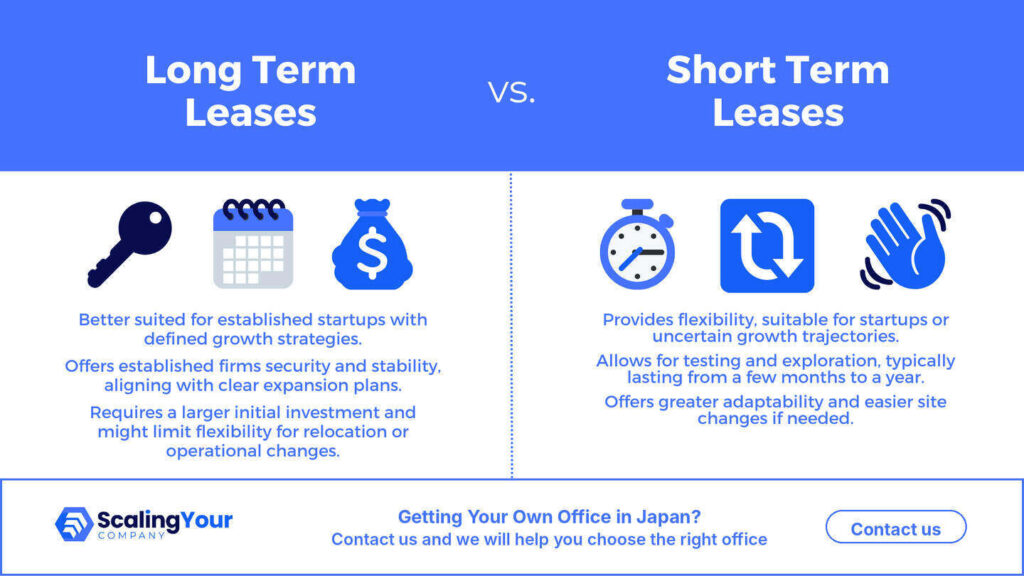
In Japan, you can opt for a short-term or a long-term lease. A long-term lease will give you some extra peace of mind as it can run for several years, while a short-term lease might let you test out different offices and get the feel of each space, and normally lasts from a few months to a year. In prime locations, leases can last as long as three to five years, and some locations even require 10 years minimum!
Our founder, Tyson Batino, opened 12 One Coin English schools across Tokyo, Chiba, Yokohama, and Saitama. In his experience, two-year leases were standard, sometimes three or four years, though there was usually room to negotiate on rent.
For established firms with a clear grasp of their future expansion plans, long-term leases can provide additional security and assurance. Compared to short-term leases, they can also give you more negotiation power and cheaper rental prices. Long-term leases, however, can necessitate a bigger up-front investment and could not be as flexible if the company wants to move sites or modify the way it operates.
Short-term leases are often more flexible and might be a viable alternative for organizations that are just starting, like a startup that has raised or is seeking venture capital, or are uncertain about their future growth plans. These leases often don’t demand a lengthy commitment and have fewer upfront costs. Additionally, they may offer more chances for companies to experiment and look around before signing a long-term lease.
The decision between a short-term and long-term lease will ultimately be based on your particular business needs, objectives, and financial constraints.
Before selecting a choice, it’s crucial to carefully weigh all of your options and consult a professional in Japan. Once you’ve decided on a specific length for your rental, you’ll also be able to determine what kind of lease best suits your needs. Japan has three main lease types that you need to know about.
Membership Sign-up for a Japanese Office
This type of lease is a relatively new concept in Japan, but has gained popularity over recent years. It is commonly used for renting out serviced offices to businessmen for shorter periods. The flexibility that membership sign-up offices offer is one of their key benefits. Depending on their needs, members can select from a variety of membership plans, including hourly, monthly, and yearly options for a private office, on average for one year, based on our experience setting up companies at Smart Start Japan.
This makes it an ideal option for those who need a workspace on a part-time or occasional basis. This lease type might be beneficial if you’re in that “trying out” phase or sailing through an uncertain period in your career. A membership sign-up lease allows you to maintain the integrity of having a Japanese office, without tying you down to any space for too long. With lower up-front costs and no long-term commitments, they provide a more affordable option to conventional Japanese office spaces.
Members will typically have to sign up and renew to access all the benefits of the rented office. One good example of a company that offers this kind of service is Regus. You can subscribe to a membership plan that they offer and choose the style of office setup you prefer according to your business needs.
Fixed Rental Agreement for a Japanese office
What’s worth remembering about this type of lease in Japan is that it involves a nonrenewable agreement. That means that you and the person/company you’re renting from will determine a set period of time for the rental, and that will be it.
While you can’t renew a fixed rental agreement in Japan, the good news is that such a lease doesn’t involve a maximum period of time. Since there are no actual restrictions as to the length of the lease, you may find that fixed rental agreements are beneficial when renting your own Japanese office.
How does this work? Aside from the fixed rental agreement, the lessor (that is, the person from whom you’re renting) will also provide an additional document. This one will state the finite period of your contract. So if you settle on a one-year contract at the time of leasing, you won’t be able to modify that later on, should you wish to do so. This additional document also informs you of the nonrenewable quality of your lease.
Generally, in case the leasing period exceeds 12 months, the lessor will be legally obliged to furnish you with a termination notice anywhere from 6 to 12 months before your contract is up. This is designed to offer you ample time to figure out your next steps and find a new space to rent. During the fixed rental agreement period, the rent amount cannot be increased by the landlord. This offers tenants consistency and predictability in their monthly costs, which can be very helpful for companies that need a steady budget.
Attention: While fixed rental agreements are nonrenewable, there’s no rule anywhere preventing the two parties from entering a new leasing agreement immediately after the first one expires. So basically, if both you and the lessor are satisfied with the conditions of your lease and would like your current arrangement to continue, you may sign a new rental agreement. However, you may be subjected to an additional fee.
Let us help you 2x-5x your business in Japan
We can help you scale your company in Japan and internationally through one on one and group coaching, online courses, and a marketing agency service.

Normal Rental Agreement
Last but not least, we’ve got the traditional rental agreement that we see everywhere in the world. Typically, this is a set agreement for two years, with the option for renewal under the Land and Building Lease Law in Japan, should both parties desire it. It’s not uncommon to be subjected to an additional renewal fee should you opt for this one.
Aside from being a type of contract you’re probably accustomed to already, the normal rental agreement type offers the huge benefit of protection under the law. This means your lessor can’t just randomly decide to terminate your lease for no good reason, as Japan has pretty strict leasing regulations. Generally, the lessor will have to provide compelling arguments about lease history, the condition of the property, or the various benefits to either the lessor or tenant to get out of the contract early.
What sometimes happens is the owner sells the location, and the new owners tell you that they are breaking down the building. In this case, you can hold your ground, but if you would like to move locations, we recommend negotiating with them to pay for your moving costs. This is not likely to happen, but you can try to negotiate with them to cover some of the rent for the inconvenience. We recommend checking out the Japan Expat Network on Facebook for more tips on dealing with problem situations with rental agreements.

Styles of Japanese offices
Now that we’ve talked a bit about the main lease types in Japan that you might pick from, let’s look at the different design styles you might want for your Japanese office. Obviously, if opting for a serviced office, for instance, you won’t have any say when it comes to the design of your office.
And yet, the way your office looks, the design, the style, and the decor, are one of the first things prospective clients will notice about you. Before they even arrive in your office or meeting room and sit down, they will have to pass through your hallway and reception area. And that will give them an idea about who you are, as a business.
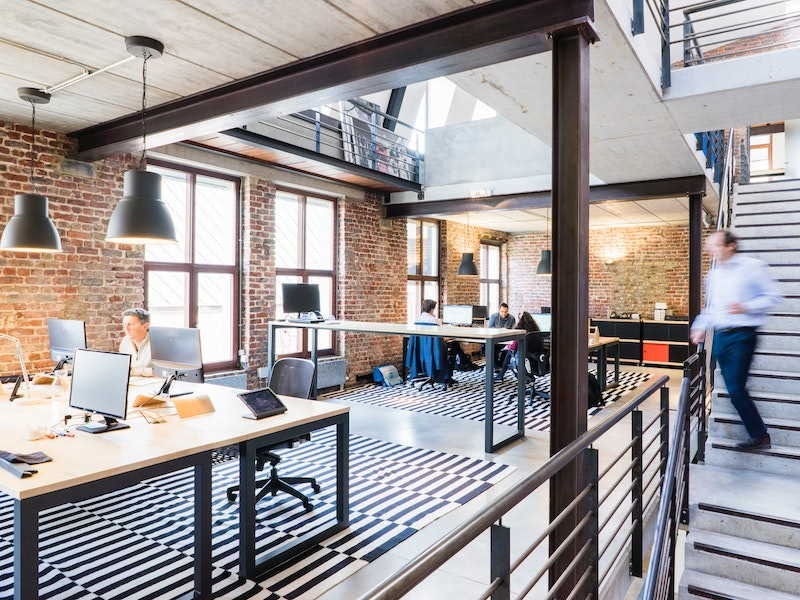
Open offices
If you’re used to a Western office design, your first time inside a Japanese office space might be quite a shock. Rather than choosing the traditional cubicle or even separate office design that you’re accustomed to, Japanese offices will usually be designed as an open plan.
In Japan, open-plan offices are becoming more and more common, particularly with startups and young companies. This style of office has a sizable common workspace where staff members collaborate in an open setting.
An open-plan office space works in shima (island) design. Meaning that individual desks are typically pushed together to form their own, independent island. The offices are angled in such a way that you will face your coworkers, while the head of the team will sit at the head of the “island”. Basically, a shima looks similar to a dinner party or a business meeting.
The idea behind the open-office design is actually a pretty interesting one. You see, Japanese companies associate walls (be it full walls or the partial separators of a cubicle) as disruptive to good communication. The closer you are to your team, the better the communication between members. An open plan improves the intimacy of a Japanese office, allowing workers to see, hear, and interact with their coworkers. It also allows teams to have meetings without having to waste time gathering the members and retiring to a special conference room.
This might appear strange at first, but if you take a closer look at Japanese homes, with their paper-thin walls, you will find an open-plan office in keeping with Japan’s disinterest in privacy.
The Japanese are also heavily focused on communication, engaging daily in the practice of horenso. This means that the head of the team will expect their team members to be in constant contact, reporting, and consulting with each other.
And if you’re worried about formal business meetings or receiving clients, don’t worry. Clients are very rarely taken to this part of a Japanese office, usually being led to a special, formal meeting room instead.
Open-plan offices do, however, have certain potential disadvantages. They may have increased noise levels, which some workers may find distracting. Moreover, open-plan workplaces may offer less privacy, which can be a problem for companies handling sensitive data.
Overall, organizations that value employee collaboration and communication should find that open-plan workplaces in Japan are a smart choice. But, it’s crucial to thoroughly assess any potential disadvantages and put strategies in place to allay these worries.
Struggling to scale your business in Japan?
Private offices
While open-plan offices are much more widespread in Japan, this doesn’t mean you won’t occasionally come across the more American private offices. If you feel like an individual working space is more appropriate for you, there are such offices available for rent in Japan, usually designed specifically for foreign businesspeople.
Businesses that need more privacy and solitary workspaces frequently choose private Japanese offices. Typically, these offices have a private workplace, desk, and perhaps even a private meeting space or lounge.
Traditional office buildings, co-working spaces, and serviced offices are just a few of the places in Japan where one can find private offices. These give workers a secluded, peaceful workspace so they can concentrate on their work without interruptions.
Moreover, private Japanese offices give companies more control over their workspace and can be tailored to their particular requirements. They can be equipped with features like high-speed internet, phone lines, and printing services, according to the needs of the company.
Private offices in Japan, particularly in upscale locales like Tokyo, can be more expensive than other kinds of office spaces. In addition, they could demand a longer-term lease commitment than other kinds of offices.
Note that for some businesses, a private office is not optional. Real estate agencies, employment placement firms, and temporary staffing agencies all need a dedicated private office to get licensed and stay compliant. If you’re incorporating in Japan, check whether your industry has specific office requirements before committing to a space.
Hybrid offices
Although rare, you might also opt for a hybrid working space. The way this works is that it takes the shima concept of the traditional Japanese office by grouping together multiple desks. However, the desks may be a little bigger (the sort of work desk you might expect in an American office), and with partial separators between them.
Hybrid Japanese offices combine traditional and contemporary office designs to provide businesses with the best of both worlds. Private offices and communal workplaces, such as open-plan sections, co-working spaces, and collaborative areas, are mixed in this type of office setting.
Private offices for staff who need more solitude can be combined with shared spaces for cooperation and communication in hybrid Japanese offices to suit the demands of certain companies. Because they can fit more people in a smaller space than typical offices, they can also be more affordable.
These types of hybrid offices will generally satisfy the privacy needs of foreigners, while not cutting them off completely from the rest of the group. In a hybrid office, you’re still working together, with ease of communication and general accessibility to your coworkers, without having to put up with the common auditory or visual disruptors of your traditional Japanese office.
Co-working spaces
Co-working spaces are a well-liked choice for entrepreneurs, startups, and small businesses in Japan. These locations provide a communal workspace where people can cooperate while working side by side.
There are multiple co-working spaces at every major station, and you can even find them in cities with as few as 100,000 ~ 200,000 people. They provide an easy-to-join and easy-to-quit business model for finding workspace and are perfect for startups or companies that are primarily remote. You can also register the co-working space as your company address if you are incorporated for an additional fee of about ¥10,000, or it might be included in your package. The monthly fee ranges from ¥12,000 with access to the cafe or open space to ¥44,000 for a fixed seat and more for a private space.
The sense of community and cooperation that co-working spaces foster in Japan is one of its advantages. People can cooperate on projects, discuss ideas, and work with other similarly-minded professionals. For freelancers and small enterprises that might not have access to a larger crew, this can be very helpful.
Nonetheless, there can be some negative aspects to co-working in Japanese offices. They might not be appropriate for all people or types of work because they can be noisy and distracting. Moreover, co-working facilities might not be suitable for organizations that need more privacy or control over their workspace.
Here is a good article on the top 10 co-working spaces in Tokyo. It has good information on the different and unique offerings some co-working spaces provide. For example, some co-working spaces focus on helping people from a specific industry or purpose, e.g., Digima Base has many companies that focus on overseas business, and Blink Roppongi has many events for foreign startups and business owners. The networking benefits can potentially outweigh the privacy provided by a Japanese office for new businesses.
Overall, co-working spaces in Japan can generally be a suitable choice for people and companies who value community and cooperation. Yet, it’s crucial to carefully weigh the potential disadvantages and make sure the space satisfies the demands of the organization or individual.
Not sure which office suits your needs?
- 100+ companies matched to the right office type for their visa and budget
- 10+ years navigating Japan office requirements in English
- Japan-based advisors with vetted real estate contacts
Conditions for renting a Japanese office
As in most countries, before you can sign a lease on your Japanese office rental, you will need to meet some pre-existing conditions. These will vary based on the area you’re renting in and the prestige associated with that. Typically, the more prestigious an area, the more conditions the lessor might impose.
But the most common renting conditions include:
- Deposit of 6-12 months rent > this is a fully refundable deposit, which you typically get back at the end of your contract. Beware that in more prestigious areas, the initial deposit can go up to a whopping 20 months’ rent.
- The real estate agent’s fee > this is usually set at one month’s rent, and is the duty of the tenant to pay upon signing the contract.
- Signing a fixed-length contract;
- Extra deposit of 1-2 months’ rent > this custom hails from the days immediately after World War II, when this non-refundable deposit would go to the costs of rebuilding. Nowadays, the lessor might deduct any additional cleaning, maintenance, or refurbishment costs from this deposit.
- You promise to return the Japanese office space in its original condition upon vacating.
- You have the possibility to end the lease, but you need to give 3-6 months’ notice.
- You may need a personal guarantor. This is a person of good standing (residing in Japan) who guarantees your reputation and accountability.
- Some landlords may also require lease guarantee insurance (typically one month’s rent).
Conditions may vary slightly, from lessor to lessor, but the above will be found in most leasing contracts for a Japanese office.
Hear from Corey Nedz on YouTube talking about the conditions and costs involved in renting a Japanese office below:
Moving into a new Japanese office
It’s crucial to properly calculate and plan for the costs involved in moving into a new Japanese office because setting up an office might initially be fairly expensive. Working with a trustworthy real estate agent is also advised because they can help you navigate the process and make sure you’re receiving a good deal.
It is also important to understand the type of business that you’re starting to build, as this will help you determine the type of office you will be choosing for your business. Determining your budget is a crucial step so that you can deduce the amount of work in looking for office spaces in certain locations in Japan, as locations play a big role in the rental prices. Some locations might not be within your budget. Additionally, it can help you determine how large the office you need is based solely on the budget. Considering starting in a SOHO (Small Office/Home Office) for startups can definitely help with lowering the cost, as these types of office spaces can be as cheap as a regular apartment.
Other aspects to consider are the licenses required for your business, which may affect your preferred location and the building that you’re interested in renting. It is because not all building owners accept all kinds of businesses, as others may affect the current renters in the building. Moreover, your target client should also be considered, as this can determine the best location for your startup.
On top of the expenses that were mentioned above, here are some additional expenses that you need to consider when moving into a new office in Japan:
- Gift money
- Fire insurance
- Guarantor company fee of 50-100%
Additionally, taking care of the construction costs if you’re planning to make some changes in the space should be considered. Depending on how much you’re willing to spend on designing the office, construction and interior expenses vary.
Additional Requirements for Setting Up an Office
When setting up an office for your business in Japan, it’s crucial to grasp local regulations and visa prerequisites. You will need a private office to create a corporate bank account and to meet the requirements of the business manager visa (link). The office’s size and functionality must align with the visa’s specifics, and that is something we can help you with at our sister company, Smart Start Japan.
When it comes to setting up an office for a standard business manager visa, specific conditions must be met. Here’s what you need to know:
- Physical Office Space: A physical business office with distinct walls, a door, and a lock is mandatory. A virtual, shared, home, or borrowed office won’t suffice. The landlord’s approval for business use is essential.
- Office Contract: The office contract must be in the company’s name and explicitly state “for business use,” not residential use. Initially, your name can be used for the contract during the company’s incorporation process, with a later update to the business name upon establishment. For those using their apartment, technically, you would need your landlord’s approval for this, but they tend to say no based on what we have heard from others in Japan.
- Business Equipment: The office space must have, or be capable of installing, necessary business equipment like PCs, desks, printers, power outlets, and internet connections, depending on your business’s requirements.
Specific additional requirements may arise based on the nature of your business. To sponsor your visa, a capital investment of 30,000,000 yen or more is obligatory (rule changed in October 2025). If you don’t get the visa, having a representative in Japan is a requirement for the corporate bank account.
Need a Visa-Ready Office in Japan?
- Dedicated physical office with walls, a door, and a lock
- ¥30M+ capital required for Business Manager Visa applicants
- 100+ companies incorporated across Japan
via SmartStart Japan
Get a Free ConsultationGovernment rental subsidies for startups in Japan
Moving into a new Japanese office can really be quite costly, so it helps that the Japanese government provides subsidies or incentives to startups. The local governments of Tokyo and Fukuoka are promoting expatriate owners in Japan for various types of businesses. They offer services from free lawyers to free accountants, to creating actual business plans. They’re also giving subsidy loans to first-time expat owners in Japan that are much easier to get than actual business or investment loans.
If you want to know more about government subsidies, here are a couple of episodes from the Scaling Japan Podcast that you should check out!
- Japanese Startup Cities with Akiko Nakagawa from Fukuoka GSC
- Get Japanese Government Money for Your Business with Miho Tanaka
Moving out of the Japanese office rental
“Leave it the way you found it,” as Corey Nedz said during the Renting An Office In Japan seminar, is the general rule when moving out of a Japanese office rental. Returning it to its original state is the best way for you to reduce costs and conveniently move on from your rental office.
One cost involved in moving out of your Japanese office rental is the cleaning cost, which the owner requires before leaving the space. Most, if not all, building owners require that the space be returned to its original look, as it is more convenient for them to look for another renter, and it’s just their general preference.
It is also important to be aware and knowledgeable of your contract terms before moving out of the rental office (this should also be the case when moving into your new office). The lease is outlined in the contract, which serves as a binding legal agreement between you and the landlord. It is best to have someone who speaks Japanese to interpret it for you properly if you are not very fluent in their language.
Re-negotiating terms in renting a Japanese office
Re-negotiating terms in renting a Japanese office can be a complex process, but it is possible under certain circumstances. Renegotiation may usually incur renewal fees, and the amount may vary depending on the agreement. The management company may take an equivalent of a month’s fee or half a month’s fee, which could be perpetual while you are staying in the space. In the renewal fees, guarantor fees may be included as well, so it is important to be knowledgeable about your contract and be aware of the perpetual fees mentioned there.
In general, it takes an open dialogue, careful evaluation of both sides’ demands, and a willingness to find a mutually beneficial solution to renegotiate rental conditions in Japan. Renegotiating rental terms and coming to an agreement that benefits all parties is doable with the correct strategy.
Terminology for renting a Japanese office
In finalizing your rental contract in Japan, you may come across some terms you’re not familiar with. Below are some of the specific terms, according to a well-known office site, you’ll need to acquaint yourself with before you begin looking for your Japanese office, which will make the process easier for you.
- Tsubo – a tsubo is a measurement unique to Japan. In renting a Japanese office, you will find many measurements in tsubo. You will most likely need 1-2 tsubo per person, for a decent-sized office.
1 tsubo = 3.3057 square meters or 35.58 square feet
- Shikikin/hoshokin – this is the security deposit you will need to pay when renting a Japanese office. This is a refundable deposit you will get back within a month of vacating the property.
- Rate per tsubo – how much one tsubo costs per month. Typically affected by factors like office location, appearance, facilities, etc.
- Koushinryou – this is the renewal fee you might be required to pay, should you desire to renew your contract. Can go up to twice the monthly rent.
- Shoukyakuhi – the non-refundable fixed amortization fee you will have to pay your lessor;
- Monthly rent – this is calculated as follows: rate per tsubo + common service fee per tsubo x size in tsubo.
- Unlisted rent – it’s not uncommon for lessors to unlist monthly rents for their properties, so make sure your search includes unlisted rents.
- Common service fee – this is a cleaning and maintenance fee charged per tsubo.
- Commission – this is the fee perceived by the real estate agent, and will usually be somewhere around one month’s rent.
- Quakeproof – many buildings in Japan are designed to withstand earthquakes.
- Free Rent Term – used as an incentive to motivate tenants, many lease agreements will have such a term, in which for every x months of renting (typically 12), you get one month free.
- Shouhizei – an obligatory sales tax that tenants must pay upon signing the lease. At the time of this writing, the shouhizei is 8%.
Where to find a Japanese office
Let’s have a look at some of the best websites where you can typically find a Japanese office for rent. Office Navy is among the top office rental agencies in Japan. They offer professional rental services, bilingual services, and fast delivery.
Instant Offices is another excellent, easy-to-use website that will help you assess your different renting options in Japan and help you find the best office space for your company.
Offices.co offers an online directory, oriented around different areas in Japan. Through them, you can secure anything from a serviced office to a co-working space, even to a virtual office, depending on your needs.
Lastly, Officee offers easy access to a host of different Japanese office buildings across Japan. They furnish you with all the details you’ll need to decide regarding your next office.
Of course, there are many other online (and offline) office renting agents and companies. We suggest looking for one that appeals to you to get the best possible results. However, make sure you check the renting company’s or website’s credentials before doing any business with them. This may include searching for online reviews, asking for accreditation, and so on. Reading about someone else’s experiences with a certain rental company can save you a lot of grief. Simply search the name of your chosen rental company, followed by “reviews,” to get an idea of their business method. If possible, you might also want to find yourself a rental property by word-of-mouth, from someone who’s used them in the past.
Areas in Tokyo for Foreign-owned Tech Startups
Tokyo is a thriving, dynamic metropolis that has numerous prospects for tech enterprises with foreign ownership. Tokyo’s top districts for foreign-owned IT enterprises include the following:
- Minato. Located southwest of the Imperial Palace, Minato hosts many embassies and is also home to various domestic companies and foreign-tech startups.
- Roppongi. Many foreign-owned tech firms are based in the well-known international business and leisure district of Roppongi. It has both contemporary office buildings and historical sites, as well as a thriving nightlife.
- Shibuya. Shibuya is a thriving commercial and leisure area that is home to a large number of cutting-edge businesses and tech startups. It is renowned for its hip cafes, shops, and nightlife, as well as for being close to research facilities and universities.
These are just a few instances of Tokyo’s prime locations for foreign-owned tech firms. While picking an office location in Tokyo, it’s crucial to keep things like location, accessibility, and facilities in mind.
More information about renting a Japanese office on our YouTube channel with Corey Nedz here:
To uncover more about the startup scene in Japan and fuel the growth of your startup, learn more about various Japanese tech companies, as well as how to kickstart Startups in Japan.
Additional Tips for Working in a Japanese Office
Japanese Office Wear
In Japan, the saying “first impressions matter” holds immense significance, especially in the context of office work. The attire chosen by office workers is a reflection of their commitment to their roles and the company’s values. Traditional Japanese office wear, often referred to as “salaryman” or “OL” fashion, involves well-fitted suits in darker hues for men, paired with conservative ties and polished shoes. Women, on the other hand, opt for elegant and modest business attire, which includes tailored suits, knee-length skirts, and neutral-colored blouses.
Japanese Office Culture
Office work in Japan extends beyond just attire and the physical office; it’s a cultural experience in itself. Punctuality, respect for hierarchy, and a strong work ethic are ingrained values in Japanese office culture. The office space is considered an extension of one’s identity, reflecting dedication and attention to detail. Setting up an office in Japan goes beyond furniture and equipment > it involves creating an environment that fosters productivity and collaboration while adhering to cultural norms.
For further insights, you can explore resources like our guide on Japanese corporate culture and Japanese business etiquette, which offers valuable information on navigating the cultural intricacies.
Need Guidance? Contact Us for Expert Referrals
If you’re seeking expert guidance on setting up an office in Japan or understanding requirements, we’re here to help. Connect with us through our contact form to receive personalized referrals from professionals well-versed in these areas. Your journey to setting up an office starts with the right advice > let us assist you every step of the way.