

Originally by Estelle Nocos | Updated April 2026
Can a foreigner start a business in Japan? Yes! Japan offers a supportive ecosystem, streamlined incorporation process, and government incentives for foreign entrepreneurs. The country’s commitment to globalization makes it an attractive destination for international business.
Setting up a company in Japan is easier than you might think, with extensive resources, step-by-step guides, and government assistance available. Recent regulatory changes have modernized the incorporation process, with faster processing times and new digital options making company formation more accessible than ever.
However, foreign entrepreneurs should be aware of significant changes that took effect in October 2025, particularly the stricter Business Manager Visa requirements that have raised the bar for those planning to operate their businesses directly in Japan. This article will guide you through the complete process to help you successfully establish your business in Japan in 2026.
The information in this article has been checked by a scrivener in Japan.
Key Takeaways
- No residency is needed to incorporate. Non-resident foreigners can own and direct a Japanese company with no Japanese national required as a director.
- 3 main structures: GK (fastest, lowest cost), KK (needed for VC investment or going public), Branch Office (no separate legal entity)
- You don’t legally need a Japan-resident director, but without one, Japanese banks will refuse to open a corporate account, and you’ll be locked out of most subsidies and loans
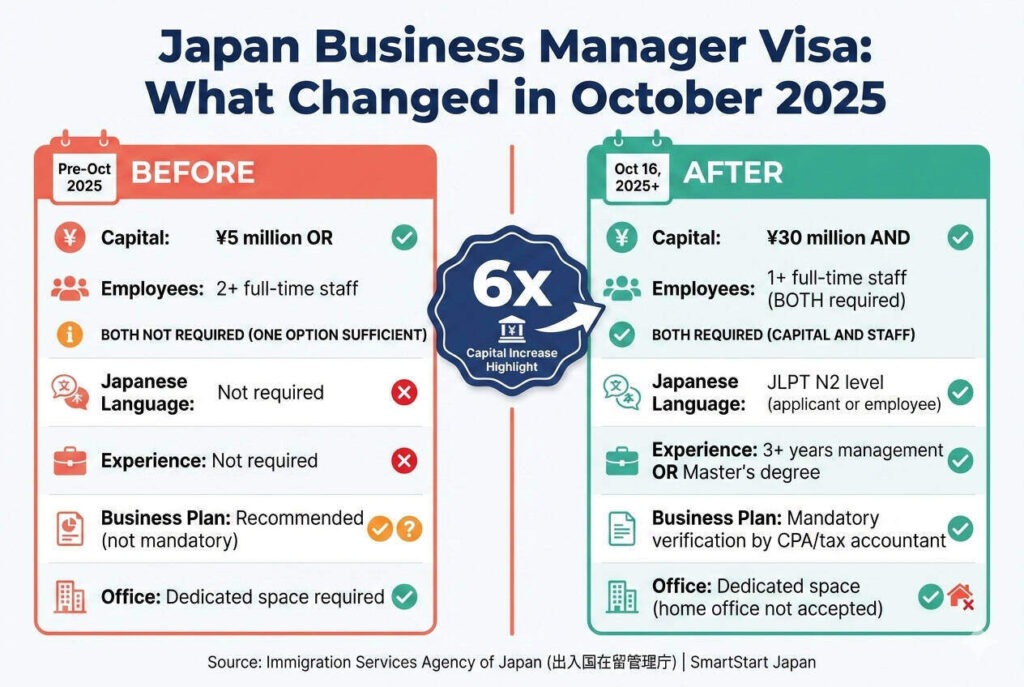
- Business Manager Visa (from October 2025): ¥30M capital, 1 full-time employee, JLPT N2, and 3+ years management experience
- Post-establishment filings have tight deadlines, some as short as 5 days (social insurance enrollment). Missing them means penalties
KK vs. GK: Which Business Structure is Right for You?
When starting a company in Japan, you’ll choose between two main structures:
1. Kabushiki Kaisha (K.K.) 株式会社
- The most recognized business structure in Japan, and the preferred structure for companies seeking to work with government entities. Used to be the preferred structure for corporations, but nowadays they are open to doing business with G.K. companies as well.
- Requires notarization to set up, which makes the setup process longer. Additionally, making changes to the articles of incorporation is more expensive for a K.K than a G.K.
- Required for venture capital investment. VC firms in Japan require a K.K. structure because it allows the issuance of shares. A G.K. cannot issue shares.
- For your share price, the most common setup is 1 share = ¥10,000 (clean for allocation). Alternatively, 1 share = ¥1 gives maximum flexibility to divide equity among multiple investors later.
- Best if you are planning to scale, raise outside investment, or build a strong corporate reputation with traditional Japanese companies.
2. Godo Kaisha (G.K.) 合同会社
- Japan’s LLC equivalent. Simpler, more flexible, and cheaper to register with no notarization required. You can incorporate it in as little as 7 days, but it normally takes around 14 days.
- Despite lower name recognition than a K.K., many of the world’s largest multinational companies use G.K. for their Japan subsidiaries. Amazon Japan, Apple Japan, and Google Japan all operate as Godo Kaisha, primarily for tax efficiency and management flexibility.
- Cannot issue shares. G.K. is therefore not suitable for startups planning to raise venture capital. If VC funding is any part of your plan, incorporate as a K.K. Ownership is split evenly among owners.
- Ideal for small businesses, freelancers, foreign-owned subsidiaries, and companies that do not need outside equity investment.
- G.K. carries less prestige than K.K due to its being simpler to set up. In the eyes of traditional Japanese companies and government agencies, this can be a disadvantage in B2B negotiations.
Cost of incorporating between a G.K. and a K.K.
The cost of incorporating a Godo Kaisha (G.K.) and a Kabushiki Kaisha (K.K.) varies due to differences in registration fees, legal requirements, and administrative procedures.
| Expense | Godo Kaisha (G.K.) | Kabushiki Kaisha (K.K.) |
| Registration Fee (登録免許税) | ¥60,000 | ¥150,000 |
| Notary Fee (定款認証手数料) | Not required | ¥30,000–¥50,000* |
| Revenue Stamp (収入印紙) | ¥40,000 (paper) / ¥0 (electronic) | ¥40,000 (paper) / ¥0 (electronic) |
| Certified Copy Fee (謄本手数料) | N/A | ~¥2,000 |
| Company Seal (Inkan) | ¥10,000–¥20,000 | ¥10,000–¥20,000 |
| Total Estimated Cost | ¥110,000~¥300,000 | ¥232,000~¥450,000+ |
*Please note that these are only estimates, and the actual fees will vary based on your situation and the company you’re trying to create.
Not Sure Which Structure Is Right for You?
- KK and GK incorporation handled end to end, in English.
- Structure advice before you commit.
- Trusted by 100+ companies incorporated across Japan.
via SmartStart Japan
Book a Free ConsultationCost-Saving Options:
Using an electronic Articles of Incorporation (電子定款) eliminates the ¥40,000 revenue stamp fee. Additionally, completing a municipal Tokutei Sōgyō Shien (特定創業支援等事業) program can reduce registration fees by 50%, lowering the K.K. registration fee to ¥75,000 and the G.K. fee to ¥30,000.
Additional Costs Not Included
What are the Visa and Residence Requirements for Setting Up a Company in Japan?
Navigating Japan’s business landscape, particularly understanding visa and residence requirements, can be complex. This section offers a concise guide to help you be confident in setting up a company in Japan.

The Business Manager Visa (経営・管理ビザ) is required for foreign nationals who want to start and operate a company in Japan without an existing long-term residence status. Following the October 2025 reforms, this visa now has substantially stricter requirements.
Key Requirements (Effective October 16, 2025):
- Capital Investment: A minimum of ¥30 million in paid-in capital (資本金) for corporations, or equivalent investment in business assets for sole proprietors.
- Employment Requirement: At least one full-time employee (常勤職員) must be hired. This employee must meet specific criteria:
- Work at least 30 hours per week
- Be enrolled in employment insurance (雇用保険)
- Receive at least 10 days of annual paid leave after 6 months of continuous employment
- Cannot be dispatched, outsourced, or seconded workers
- Japanese Language Ability: Either the applicant or at least one full-time employee must demonstrate “相当 程度 の日本語能力” (substantial Japanese ability), equivalent to JLPT N2 level.
- Management Experience or Education: The applicant must have either:
- Three or more years of experience in business management or administration, OR
- A master’s degree, doctoral degree, or professional degree (専門職学位) in a field related to business management
- Business Plan Verification: A business plan must be reviewed and verified by a qualified professional, such as a Certified Public Accountant (公認会計士), tax accountant (税理士), or SME Management Consultant (中小企業診断士).
- Office Space: A dedicated office with a lock and nameplate is required. Home offices, co-working spaces, and virtual offices are generally not accepted.
Important Considerations:
You can legally incorporate a company in Japan without a visa, but you cannot personally manage and operate the business as a resident in Japan without an appropriate residence status, like a business manager visa or permanent residence, which allows for running a business. Running a business under an employment visa, dependent visa is a violation of the visa and cannot result in visa termination. Immigration officers retain discretion over approvals, and meeting the minimum requirements does not guarantee visa issuance.
The application process typically takes 3 to 12 months from initial consultation to visa approval, including time for company incorporation, office setup, employee hiring, and immigration processing. Please note that Tokyo takes longer to get a business manager visa than other regions, based on seeing more than 30 applications.
For a complete guide to the application process and required documents, read our article on How to get a Business Manager Visa in Japan.
Alternatives If You Don’t Qualify for a Business Manager Visa
Given the significantly higher requirements for the Business Manager Visa, foreign entrepreneurs should carefully consider alternative pathways:
Partner with a Japanese Co-Founder or Manager:
A Japanese national or permanent resident can serve as the company’s representative director (代表取締役) while you participate in the business under a different arrangement. This allows the company to operate without you personally holding a Business Manager Visa, though your involvement must align with your actual residence status.
Apply for an Alternative Visa Type:
Several visa categories allow business involvement without the strict Business Manager Visa requirements:
- Startup Visa (スタートアップビザ): As of January 2025, the two previous startup visa programs have been unified into a single nationwide system. This visa provides up to 2 years for entrepreneurs to prepare their business before transitioning to a Business Manager Visa. Available through certified local governments and private accelerators across Japan.
- J-Find Visa (未来創造人材): A visa for graduates of top-ranked global universities who wish to pursue entrepreneurship or job-seeking activities in Japan. Allows up to 2 years of stay.
- Highly Skilled Professional Visa (高度専門職): A points-based visa for professionals in business management, research, or technical fields. Offers faster paths to permanent residency and allows entrepreneurial activities.
- Spouse Visas: If you have a Japanese spouse or spouse of an individual with permanent residence, you may be able to engage in business activities with proper permission.
Acquiring a Startup Visa
The Startup Visa is a temporary residency program designed to attract innovative foreign entrepreneurs. Unlike the Business Manager Visa, it does not immediately grant Business Manager status but provides 6 to 12 months for entrepreneurs to set up their business in Japan.
During this period, visa holders must meet the requirements to transition to a Business Manager Visa, which now reflects the October 2025 reforms:
- Capital investment of ¥30 million (required by most participating cities)
- At least three years of management experience and JLPT N2 Japanese language proficiency
- A physical office space (home offices and virtual offices are not accepted)
- A verified business plan reviewed by a CPA, tax accountant, or SME consultant
- At least one full-time employee (where applicable)
*As of April 2026, only two startup cities do not require the full ¥30 million capital upfront to apply for the Startup Visa.
Local governments, rather than national authorities, offer this flexible visa program. To qualify, you need to submit a new business implementation plan demonstrating that your business idea can contribute significantly to Japan’s economy. If the local government approves your plan, you are then eligible to apply for the Startup Visa. Check out this list of startup-friendly cities.
Can I Open a Company in Japan as a Non-resident?
Yes, a non-resident can register a company in Japan, but there are important limitations to consider.
What You Can Do as a Non-Resident:
- Register a business – You can incorporate a Kabushiki Kaisha (KK) or Godo Kaisha (GK) without a visa or Japanese address.
- Own shares in a Japanese company – Foreigners can be company shareholders without living in Japan.
- Appoint a Japanese resident director (strongly recommended, but not legally required). Japan removed the legal residency requirement for KK representative directors in March 2015. A KK can legally be incorporated with zero resident directors.
In practice, however, all Japanese banks will refuse to open a corporate account for a company without at least one Japanese resident director. Some companies can provide a nominee director, like Smart Start Japan. What You Cannot Do as a Non-Resident:
- Open a corporate bank account before having a resident director – Most Japanese banks require at least one company director to be a Japanese resident.
- Legally operate the business without a valid visa – If you plan to run the company yourself in Japan, you must apply for a Business Manager Visa or another suitable visa.
- Sign a lease or close deals with cautious business partners – many Japanese landlords and companies won’t engage if the representative has no Japanese residency. There is no law stopping you from signing contracts without a visa, but the practical barriers are real.
Workarounds for Non-Residents
If you’re a non-resident wanting to set up and operate a company in Japan, you can:
- Partner with a Japanese resident who can serve as the initial director.
- Apply for a Business Manager Visa after company registration.
- Use a professional service (e.g., legal consultants or accounting firms) to assist with registration and bank setup.
Setting Up From Outside Japan? We Handle the Process.
- Nominee director service for bank and registration requirements.
- KK and GK incorporation without being in Japan.
- Trusted by 100+ companies incorporated across Japan.
via SmartStart Japan
Get Started TodayDifferent Options for Setting Up a Company in Japan
Alternatively, if you are a non-resident interested in setting up a company in Japan, you have various options to consider. The right choice depends on your specific needs and goals.
Representative Office
A Representative Office, offering an easy establishment process, can conduct market research, information collection, or advertising. However, it’s not permitted for sales or profit-oriented activities.
Key Features
- No registration required with the Legal Affairs Bureau.
- No corporate tax obligations since it doesn’t generate revenue.
- Can hire local staff, but salary payments must be managed from the parent company abroad.
- Limited banking options, as corporate accounts may not be available.
Who Should Consider a Representative Office?
- Foreign businesses exploring the Japanese market before full entry.
- Companies that need a local presence for research, networking, or promotions without engaging in sales.
If you plan to conduct commercial activities, you may need to establish a Branch Office, Godo Kaisha (G.K.), or Kabushiki Kaisha (K.K.) instead.
Branch Office
A Branch Office allows profit-making operations and can lease property and open bank accounts under its name. But it’s not a separate legal entity, with the parent company accountable for its liabilities.
Key Features
- Can engage in sales, sign contracts, and generate revenue.
- Requires registration with the Legal Affairs Bureau.
- Must appoint a resident representative in Japan.
- Liabilities and financial obligations fall on the parent company.
Important Limitations of a Branch Office
Before choosing this structure, be aware of two significant practical disadvantages that most guides do not mention:
- Banking is significantly harder. Japanese banks treat branch offices of foreign companies with extra scrutiny. Most major banks (Mitsubishi UFJ, Mizuho, SMBC) and online banks are reluctant to open accounts for foreign branch offices as the liabilities fall on a parent company in a country with no jurisdiction. Not eligible for Japanese government subsidies. Branch offices are generally excluded from Japan’s startup subsidy programs, municipal support schemes, and the Tokutei Sōgyō Shien (特定創業支援等事業) registration fee reduction program. These programs are reserved for independently incorporated Japanese entities.
Who Should Consider a Branch Office?
- Foreign companies that want a local presence without forming a separate entity, and do not require Japanese bank accounts or subsidy access.
- Businesses looking to test the Japanese market before committing to full local incorporation.
For companies seeking limited liability and independent legal status, establishing a Kabushiki Kaisha (K.K.) or Godo Kaisha (G.K.) may be a better option.
Subsidiary Company
A Subsidiary Company is an independent legal entity, ideal for limiting the parent company’s liability. As mentioned before, there are three types of subsidiaries when setting up a company in Japan: Kabushiki Kaisha (joint-stock corporation), Godo Kaisha (LLC), and Gomei Kaisha (general partnership), each with unique regulations regarding capital, liability, and management.
It is worth noting again that the Godo Kaisha structure, similar to an LLC, has gained popularity among multinational corporations like Google and Apple due to its flexible management and operational provisions. By adopting the G.K. model as these companies have done, businesses can effectively navigate the dynamic business environment in Japan, securing their growth and expansion in this globally significant market.
What are the Tax Requirements?
When setting up a company in Japan, familiarizing yourself with the tax requirements is just as essential as learning about the visa and residence requirements to do business in this country.
Type of Company and Taxation
In Japan, just like many other countries, the type of business you set up directly affects the kind of taxes you’ll be obligated to pay. The selection between different business structures, including sole proprietorships, partnerships, and corporations, brings along specific tax implications that must be factored in during the planning stage.
Corporations in Japan are subject to three main taxes: corporate tax, inhabitant tax, and enterprise tax. Here are the key rates for most small foreign-owned companies:
| Tax | Rate | Notes |
| National corporate tax | 23.2% | Standard rate |
| SME reduced rate | 15% | On first ¥8M of annual income for companies with capital under ¥100M |
| Inhabitant tax | ~6–7% of corporate tax | Varies by municipality |
| Enterprise tax | ~3–7% | Varies by size and prefecture; deductible the following year |
| Effective combined rate | ~30–35% | Typical for a small Tokyo-based company |
| Consumption tax (JCT) | 10% standard / 8% reduced | New companies with capital under ¥10M are exempt for the first two years |
Important for new companies: the Qualified Invoice System (インボイス制度)
Since October 2023, Japan requires registered businesses to hold a T-number (qualified invoice issuer registration) to pass on consumption tax credits to their clients. Even if your new company qualifies for the two-year consumption tax exemption, your business clients cannot claim input tax credits on your invoices unless you are a registered invoice issuer. This can make you less competitive as a vendor to larger Japanese companies. Discuss the timing of your T-number registration with your tax accountant before you incorporate. See the video below for a more detailed explanation.
What is the Overall Process of Setting Up a Company in Japan?
Setting up a company in Japan follows a structured and well-defined process. Recent regulatory improvements have made incorporation faster. Here’s a step-by-step summary:
- Drafting the Articles of Incorporation (定款 / Teikan): Prepare this legal document outlining your company’s structure, purpose, officials, and registered business address. For K.K. companies, get it notarized at a public notary office (公証役場).
- Filing for Business Registration: Submit the notarized (if applicable) Articles of Incorporation to the Legal Affairs Bureau (法務局). Processing typically takes 1–2 weeks, though expedited online processing can be completed in as few as 3 days.
- Depositing Capital: Transfer the initial capital into the representative director’s personal bank account and keep proof of deposit. This must be completed before registration.
- Opening a Corporate Bank Account: Once your company is officially registered, set up a corporate bank account to manage business finances and transactions.
- Obtaining Necessary Licenses and Permits: Certain industries require specific licenses or permits before operations can begin.
Accelerated Processing Options:
As of March 2025, all notary offices nationwide now offer 48-hour processing for articles of incorporation certification. When combined with online registration filing, the entire incorporation process (from notarization to registration completion) can be completed within 72 hours for applications that meet specific criteria:
- Electronic articles of incorporation
- Online registration application within 1 week of notarization
- All supporting documents submitted as electronic files (PDF)
- Application meets 48-hour processing requirements
New: Weekend and Holiday Establishment Dates (From February 2, 2026):
Starting February 2, 2026, entrepreneurs can designate weekends, national holidays, and even January 1st as their company establishment date. To use this option, submit your registration application on the last business day before the desired date and include a statement requesting the specific date as your establishment date.on process.
Unlike the US, where the fiscal year runs January to December by default, Japan lets you set your fiscal year to whatever 12-month period you choose, and it’s anchored to your establishment date. For example, if you incorporate on June 1, 2026, your fiscal year can run from June 1, 2026, to May 31, 2027. This flexibility lets you align your fiscal year with your business cycle, seasonal revenue patterns, or your home country’s reporting calendar, rather than being locked into the calendar year.
Setting Up a Company Step-by-step
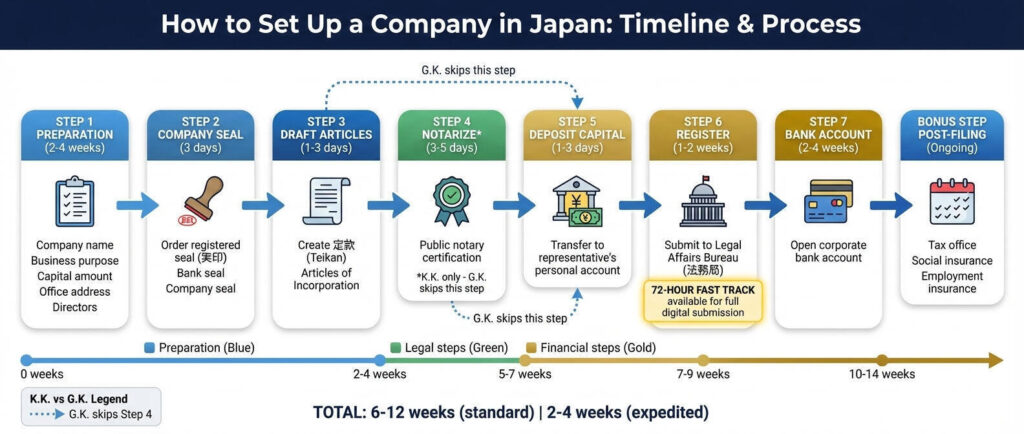
Step 1: Define Key Business Details
Before setting up your business in Japan, you need to establish essential details to ensure a smooth registration process.
1. Choose a Business Structure
Decide between:
- Kabushiki Kaisha (K.K.) – A corporation offering credibility, ideal for larger businesses and those seeking investment.
- Godo Kaisha (G.K.) – A simpler, lower-cost option similar to an LLC, suitable for startups and small businesses.
2. Select a Unique Company Name
Your company name must comply with Japanese regulations and be unique within your registration jurisdiction. Check name availability on the Corporate Number Publication Site (法人番号公表サイト).
3. Define Your Business Purpose
Clearly outline your company’s activities. These will be written into your Articles of Incorporation and become your legally registered business scope. If you plan to apply for a Business Manager Visa, also prepare a detailed business plan (allow 2–4 weeks), which must be verified by a CPA, tax accountant, or SME consultant.
A note from experience: Having personally introduced more than 60 companies to a licensed judicial scrivener (司法書士), one of the most common and costly mistakes we see is founders writing overly narrow business objectives. Include not just what you plan to do immediately, but everything you might reasonably pursue over the next 3–5 years: consulting, e-commerce, events, recruitment, or any adjacent service.
Another tip from working alongside our 司法書士: every teikan should end with the catch-all clause “前各号に附帯または関連する一切の事業” (any business incidental or related to the preceding items). This single line saves countless founders from re-amending their articles every time they expand into an adjacent service. It will not stretch to entirely new industries, though, and for regulated activities like real estate, recruitment, used goods (古物商), financial services, and alcohol sales, you’ll need the exact statutory wording, because the licensing authority cross-checks the teikan against your license application. Business Manager Visa applicants should also make sure the listed purposes clearly mirror the business plan submitted to immigration.
Why does this matter? Changing your Articles of Incorporation after registration requires a formal amendment process with real costs:
| Cost Item | Approximate Cost |
|---|---|
| Re-notarization fee (K.K. only) | ¥30,000–¥50,000 |
| Re-registration filing fee | ¥30,000–¥60,000 |
| Judicial scrivener fee (recommended) | ¥50,000–¥100,000 |
| Total for a simple amendment | ¥80,000–¥200,000+ |
| Time required | 1–3 weeks |
Getting your business objectives right the first time eliminates this cost. A good judicial scrivener will help you write objectives that are broad enough to protect your future options without being so vague that they create complications with visa or banking applications.
Here’s an example for business purposes:
- 経営コンサルティング及びビジネスサポートサービス業務 (Business management consulting and support services)
- インターネットを利用した情報提供及びマーケティングサービス業務 (Internet-based information and marketing services)
- ソフトウェア及びデジタルコンテンツの企画・開発・販売 (Planning, development, and sale of software and digital content)
- 教育、研修及びセミナーの企画・運営・提供 (Planning, operation, and provision of education, training, and seminars)
- 商品の輸出入及び国内外における販売 (Import/export and domestic/overseas sale of goods)
- 前各号に附帯関連する一切の事業 (All businesses incidental or related to the above)
4. Secure a Japanese Address & Phone Number
Your business needs a registered office address in Japan:
- Physical office – Required for Business Manager Visa applications and corporate bank account
- Virtual office – Allowed for registration only; not accepted for visa applications or bank accounts
- Home address – Only if permitted by your landlord and local regulations. Can work for bank accounts.
A Japanese phone number goes on official documents and is required for bank registration. Use your own if you have one. If you’re not in Japan yet, a contact’s Japanese number works, though banks and immigration will generally prefer to see the applicant’s own number on file.
5. Decide on a Head Office Location
Choose the official address where your business will be legally registered. If you need help with office space, check our guide on renting offices in Japan.
6. Determine Your Initial Capital
You can legally register a company with as little as ¥1, but higher amounts improve credibility with banks and business partners. Consider these factors:
- For visa purposes: If applying for a Business Manager Visa, you need ¥30 million minimum (as of October 2025)
- For banking: Many banks prefer companies with ¥1 million or more in capital, but recently we recommend a minimum of 3 million and ideally 5 million yen to improve your chances.
- For credibility: ¥5million or more is common for companies seeking to work with larger Japanese firms. 3 million yen can work, but 5 million is a safer number.
7. Set Key Company Dates
- Establishment Date: The date your company will be officially registered. From February 2, 2026, weekends and holidays can also be designated as establishment dates.
- Fiscal Year: The standard fiscal year in Japan runs from April 1 to March 31, but you can use any 12 months. Unlike in the US, where the calendar year is the default, you have full flexibility here. Incorporating on June 1 and setting your fiscal year to June 1–May 31 is perfectly normal. It also means you get the full first-year consumption tax exemption window.
8. Appoint Directors & Shareholders
Define roles and responsibilities:
- K.K.: Requires at least one director. While not legally required, having at least one Japan-resident director is strongly recommended to open a corporate bank account (see the non-resident section for details) or to get access to loans and subsidies
- G.K.: Needs at least one member (社員), who can also act as the representative member.
What happens when there are multiple shareholders?
For a K.K. with multiple shareholders:
- All shareholders must sign or consent to the Articles of Incorporation at the founding stage.
- Major decisions (amending the articles, mergers, dissolution) require a special resolution: at least two-thirds of shares present at a meeting where more than 50% of all shares are represented
- Ordinary decisions (electing directors, approving financial statements) require a simple majority
- One person can be both the sole shareholder and the representative director simultaneously, which is the simplest structure for a solo founder
- Shareholders and directors can be entirely different people, which is common in funded companies where investors hold shares but founders run daily operations
Corporate ownership vs. personal ownership
Your company’s shares can be held either by you as an individual or by another corporation (foreign or Japanese). This is one of the most overlooked structural decisions at incorporation:
| Personal Ownership | Corporate Ownership | |
| Who holds the shares | You as an individual | A foreign or Japanese holding company |
| How profits are extracted | Salary (payroll tax applies) or dividends (20.42% withholding tax) | Dividends may qualify for the inter-company dividend exemption (配当控除), potentially reducing the effective tax rate |
| Most common for | Solo founders, small businesses | Multinational subsidiaries, holding structures, and tax-efficient group setups |
| Complexity | Lower. Simpler accounting. | Higher. Requires group-level accounting and additional filings. |
For most individual foreign founders, personal ownership is the right starting point. For established foreign companies setting up a Japan subsidiary, corporate ownership through a holding structure is typically more tax-efficient. Discuss this with a tax accountant (税理士) before you incorporate, as restructuring ownership after the fact is much harder and more expensive.
Step 2: Create a Company Seal
In Japan, a company seal (Hanko or Inkan) is required for official business transactions, including company registration, contracts, and banking. There are several types of company seals, each serving a different purpose.
Registered Seal (Jitsuin / 実印)
- Purpose: Serves as the official company seal for legal and corporate identification.
- Registration: Must be registered with the Legal Affairs Bureau (法務局).
- Usage: Required for company registration, legal contracts, and financial transactions.
Bank Seal (Ginko-in / 銀行印)
- Purpose: Required to open a corporate bank account and authorize financial transactions.
- Registration: Registered directly with the bank at account setup.
- Usage: Needed for deposits, withdrawals, loan agreements, and other banking transactions.
Company Seal (Kaisha-in / 会社印)
A general-purpose stamp used for day-to-day operations, such as invoicing and internal documents. No official registration is required, unlike the Jitsuin or Ginko-in. Commonly used for non-legal documents, but not valid for official contracts or banking.
Representative Seal (Daihyosha-in / 代表者印)
- Purpose: Used by the company representative (e.g., president or CEO) for signing official contracts and important documents.
- Registration: Must be registered with the Legal Affairs Bureau (法務局) during company incorporation.
- Usage: Required for legal agreements, tax filings, and major financial transactions.
- Duration: approx. 3 business days
How to Get a Company Seal
You can purchase company seals from the following sources:
- Hanko Shops (はんこ屋) – Specialized stores found in most cities
- Online Seal Makers – Platforms like Hanko.com, InkanShop, or Rakuten Hanko Stores offer custom engraving and delivery.
- Department Stores & Stationery Shops – Retailers like Loft, Tokyu Hands, and Ito-Yokado provide professional hanko-making services.
- Local Print & Stamp Shops – Small businesses in business districts that offer custom Hanko engraving.
Make sure the seal meets the Legal Affairs Bureau (法務局)or bank requirements if needed.
Step 3: Draft Articles of Incorporation (Teikan / 定款)
The Articles of Incorporation (定款 / Teikan) is the foundational legal document for your company, often called the “company constitution.” It must outline the company name, business objectives, head office address, capital amount, fiscal year, and details of directors and shareholders.
Format Requirements:
- Must be written in Japanese for official registration
- Can be prepared as a paper document or an electronic document (電子定款)
Copies Needed:
If using paper format, print and bind three copies:
- For notarization (required for K.K. companies)
- For submission to the Legal Affairs Bureau
- For company records
Electronic vs. Paper Articles:
| Format | Revenue Stamp | Processing Speed | Additional Requirements |
| Paper (紙定款) | ¥40,000 required | Standard | Physical submission |
| Electronic (電子定款) | Not required | Faster (48-72 hour option) | Digital signature, PDF format |
Using electronic articles of incorporation saves ¥40,000 in stamp duty and qualifies for expedited processing.
Notarization Requirement:
If establishing a Kabushiki Kaisha (K.K.), the Articles must be notarized at a Public Notary Office (公証役場) before submission. This step is not required for a Godo Kaisha (G.K.).
Step 4: Notarize Articles of Incorporation
Articles of Incorporation serve as the constitution of a corporation, outlining its purpose, internal structure, and activities. They can exist as written or electronic documents that formally establish company rules.
For certain companies, such as a Kabushiki Kaisha (K.K.), the Articles must be notarized by a notary public attached to the Legal Affairs Bureau before they are legally recognized. However, any changes made after company registration do not require notarization.
Notarization Fees
- Notarization Fee: 50,000 yen (excluding the cost of a certified copy).
- Stamp Duty: 40,000 yen (additional cost).
Duration: approx. 3 business days
Check out our detailed article for a full breakdown of registration fees, office costs, visa requirements, and more.
Step 5: Deposit Capital
Use the Representative Director’s Personal Bank Account. Since the company does not yet have a corporate bank account, the initial capital must be deposited into the representative director’s personal account.
- Deposit the Full Capital Amount: Ensure the amount matches what is stated in the Articles of Incorporation.
- Keep Proof of Deposit: Retain a copy of the bankbook (通帳/Tsūchō) showing the transaction or an official bank statement as proof.
- Include Required Details: The bank document should clearly display the deposit amount, the account holder’s name, and the transaction date, as this will be submitted during company registration.
Once the company is officially registered, you can transfer the funds into a corporate bank account under the company’s name. Transferring investment money to a bank account takes approx 1 to 3 business days.
Step 6: Register the Company
To officially establish your company in Japan, submit the required documents to the Legal Affairs Bureau (法務局) that has jurisdiction over your company’s registered address.
Required Documents:
- Application Form (設立登記申請書) – The official company registration application
- Notarized Articles of Incorporation (定款) – Required for K.K.; G.K. does not require notarization
- Directors’ and Shareholders’ Consent Forms – Signed documents confirming acceptance of positions
- Proof of Capital Deposit – Bankbook copy or bank statement showing the capital transfer
- Company Seal Registration Form (印鑑届書) – For registering the official company seal (Jitsuin)
- Registration Fee (登録免許税) – Paid via revenue stamps (収入印紙):
K.K.: ¥150,000 (or 0.7% of capital, whichever is higher)
G.K.: ¥60,000 (or 0.7% of capital, whichever is higher)
The fee increases as your registered capital increases. This catches many Business Manager Visa applicants off guard. If you are registering ¥30 million in capital, your K.K. registration fee is no longer ¥150,000:
| Registered Capital | KK Registration Fee | GK Registration Fee |
| Up to ~¥8.57M | ¥150,000 (flat minimum) | ¥60,000 (flat minimum) |
| Up to ¥21.4M | ¥150,000 (flat minimum) | 0.7% of capital |
| ¥21.5M | ~¥150,500 (0.7%) | ~¥150,500 (0.7%) |
| ¥30M (BM Visa minimum) | ¥210,000 | ¥210,000 |
| ¥50M | ¥350,000 | ¥350,000 |
| ¥100M | ¥700,000 | ¥700,000 |
Submission Methods:
| Method | Processing Time | Notes |
| In-person at Legal Affairs Bureau | 1–2 weeks | Standard option |
| By mail | 1–2 weeks | Date received = establishment date |
| Online (登記ねっと) | 3–10 days | Available 8:30–21:00 on weekdays; fastest option |
Online Registration Benefits:
- Company seal submission is optional for online applications (since February 2021)
- Faster processing, especially when combined with electronic articles of incorporation
- Can qualify for 72-hour combined processing
Important Dates:
- Establishment Date: The date your application is received by the Legal Affairs Bureau
- Registration Completion Date: Typically 1–2 weeks after the establishment date
From February 2, 2026, you can designate weekends, national holidays, or January 1st as your establishment date by submitting your application on the preceding business day with a written request specifying your preferred date.
Step 7: Open a Business Bank account
Requirements to Open a Corporate Bank Account:
- Company registration certificate (登記事項証明書) – Issued by the Legal Affairs Bureau (available approximately 1–2 weeks after registration)
- Registered Company Seal (Inkan) – The same seal registered with the Legal Affairs Bureau
- Business plan or proof of business activities
- Identification documents for representatives
- Japanese resident director – Most major banks require at least one director with a Japanese address
- Office lease contract – To verify a physical business address
Bank Options for Foreign Entrepreneurs:
| Bank Type | Examples | Ease of Opening | Notes |
| Major banks (メガバンク) | Mitsubishi UFJ, Mizuho, SMBC | Difficult | Highest credibility; strict requirements |
| Regional banks (地方銀行) | Various by region | Moderate | Maybe more flexible for local businesses |
| Online/New banks | SBI Shinsei, Rakuten Bank, PayPay Bank, GMO Aozora | Easier | No English support available; faster processing. Less strict on company traction |
Tips for Success:
- Prepare a detailed business plan in Japanese
- Ideally, have some customers paying you already
- Choose a bank where you have an existing personal account, if possible
Expected Timeline:
Bank account applications typically take 2–4 weeks for review, though some banks may take longer. The total time from company registration to having an operational bank account is usually 1–2 months. For a detailed guide on opening a business bank account, check out our step-by-step tutorial on corporate bank accounts or book a free consultation with SmartStart Japan for expert assistance.
Bank Account Setup Takes Longer Than You Think.
- Documents prepared and structured for Japanese bank review.
- Online and regional banks matched to your company profile.
- Trusted by 100+ companies incorporated across Japan.
via SmartStart Japan
Book a Free ConsultationStep 8: Complete Post-Registration Filings
New version:
After your company is officially registered, several mandatory filings must be completed within specific deadlines. Missing these can result in penalties.
Tax Office Filings (税務署):
| Document | Deadline | Notes |
| Corporate Establishment Notification (法人設立届出書) | Within 2 months of establishment | Submit to both national (税務署) and local (都道府県・市区町村) tax offices |
| Blue Form Tax Return Application (青色申告承認申請書) | Within 3 months of establishment | Enables tax benefits; highly recommended |
| Withholding Tax Office Registration (給与支払事務所等の開設届出書) | Within 1 month of the first salary payment | Required if paying salaries |
| Consumption Tax Election (消費税課税事業者選届出書) | Varies | Optional; usually deferred for new companies under ¥10M capital |
Social Insurance Filings:
| Agency | Filings | Deadline |
| Japan Pension Service (年金事務所) | Health insurance and pension enrollment | Within 5 days of becoming applicable |
| Labor Standards Inspection Office (労働基準監督署) | Workers’ compensation insurance | Within 10 days of hiring the first employee |
| Hello Work (ハローワーク) | Employment insurance | Within 10 days of hiring the first employee |
Corporate Number (法人番号): Your Corporate Number (法人番号) will be assigned automatically and published on the National Tax Agency’s Corporate Number Publication Site. This 13-digit number is used for tax filings, government procedures, and increasingly for business transactions.
How Much Does It Cost to Set Up a Company in Japan?
Setting up a company in Japan involves transparent, government-regulated costs plus variable professional service fees. Here’s a comprehensive breakdown:
Kabushiki Kaisha (K.K.) – Minimum Legal Costs:
| Item | Paper Filing | Electronic Filing |
| Notarization fee (定款認証) | ¥30,000–50,000* | ¥30,000–50,000* |
| Revenue stamp (収入印紙) | ¥40,000 | ¥0 |
| Certified copy fee (謄本) | ~¥2,000 | ~¥2,000 |
| Registration fee (登録免許税) | ¥150,000 | ¥150,000 |
| Company seal (印鑑) | ¥10,000–20,000 | ¥10,000–20,000 |
| Subtotal | ¥232,000–262,000 | ¥192,000–222,000 |
*Notarization fee varies by capital amount
Godo Kaisha (G.K.) – Minimum Legal Costs:
| Item | Paper Filing | Electronic Filing |
| Notarization fee | Not required | Not required |
| Revenue stamp (収入印紙) | ¥40,000 | ¥0 |
| Registration fee (登録免許税) | ¥60,000 | ¥60,000 |
| Company seal (印鑑) | ¥10,000–20,000 | ¥10,000–20,000 |
| Subtotal | ¥110,000–120,000 | ¥70,000–80,000 |
Optional Professional Service Fees:
| Service | Typical Cost |
| Judicial scrivener (司法書士) for registration | ¥50,000–150,000 |
| Immigration specialist (行政書士) for visa | ¥100,000–300,000 |
| Tax accountant (税理士) for business plan | ¥50,000–100,000 |
| Virtual office (for registration address) | ¥5,000–30,000/month |
Cost Reduction Option:
Completing a Tokutei Sōgyō Shien (特定創業支援等事業) program offered by many municipalities can reduce registration fees by 50%:
G.K. registration fee: ¥60,000 → ¥30,000
K.K. registration fee: ¥150,000 → ¥75,000
Where Can I Get Professional Help When Setting Up a Company in Japan?
Foreign entrepreneurs setting up a company in Japan often face a complex landscape of business rules and cultural nuances. Thankfully, professional assistance, ranging from government-backed initiatives to private service providers, can guide you through this intricate process, ensuring your venture’s seamless setup and success.
Back Office Specialist Companies
If you’re an established company looking to move quickly, a back office specialist can streamline the process. They help with faster bank account setup, company registration, accounting, tax compliance, payroll, and other operations. With deep expertise in Japan’s business landscape, they provide tailored solutions so you can focus on growing your business and serving customers.
If you are looking for a company, we can introduce one to you based on your company size and needs, from low-tier to high-tier service providers. You can reach out to us using the form below.
Local City Resources
Apart from these nationwide initiatives, local resources can also play a crucial role in setting up a company in Japan. Numerous Japanese cities, including Shibuya, Sapporo, Fukuoka, and Aichi, boast startup centers committed to nurturing new ventures. These centers provide a myriad of resources and services to guide you through the process of setting up a company in Japan.
For instance, Fukuoka City’s initiative towards nurturing startups offers a wealth of insights and support. For more information, you can listen to our podcast episode: Japanese Startup Cities with Akiko Nakagawa from Fukuoka GSC.
Are There Any Subsidies For Setting up a Company in Japan?
Japan’s dedication to a diverse business environment has resulted in numerous subsidy programs to attract foreign investment. Let’s explore these financial incentives:
Tokyo’s Special Ward Business Establishment Subsidy Program
The Tokyo Special Ward Business Establishment Subsidy Program provides financial assistance for setting up a company in Japan, specifically, businesses looking to operate in Tokyo’s special wards. It primarily targets SMEs and specific sectors, offering financial support to cover establishment costs.
JETRO’s Investment Promotion Programs
The Japan External Trade Organization is another invaluable source of financial support for foreign companies. JETRO’s Investment Promotion Programs encourage foreign direct investment in Japan. These subsidy programs cover various sectors and stages of a company’s life cycle, providing comprehensive support.
Regional Incentives
Several regional governments in Japan offer their own incentives, including subsidies, tax breaks, and preferential rent agreements for companies investing in priority sectors, reducing initial setup and operational costs.
What are Some Potential Legal Changes Coming to Setting Up A Company in Japan?
Japan continues to refine its business and immigration policies. Here are the key developments foreign entrepreneurs should monitor:
Recently Implemented Changes (2025–2026):
Business Manager Visa Reforms (October 16, 2025): The most significant recent change was the dramatic tightening of Business Manager Visa requirements, including the increase in capital requirements from ¥5 million to ¥30 million, mandatory employee hiring, Japanese language requirements, and professional business plan verification. These changes are now fully in effect.
Weekend/Holiday Establishment Dates (February 2, 2026): Starting February 2, 2026, companies can designate weekends, national holidays, and January 1st as their establishment date, providing more flexibility in choosing meaningful dates.
Upcoming and Potential Changes:
Immigration Fee Revisions (April 2025): Immigration application fees were revised in April 2025. Entrepreneurs should confirm current fee schedules with the Immigration Services Agency.
Digital Government Services Expansion: Japan continues expanding its digital government initiatives, including the gBizID system for business authentication and the Corporate Number (法人番号) system. These systems are increasingly integrated, potentially streamlining compliance requirements.
Tax Reform Proposals: The 2025 and 2026 tax reform proposals include various measures affecting corporations, including potential changes to consumption tax rules for new businesses and modifications to corporate tax rates for specific sectors.
Foreign Investment Reporting: Japan has tightened foreign investment reporting requirements for certain sensitive industries. Foreign entrepreneurs in sectors related to national security, critical infrastructure, or advanced technology should be aware of prior notification requirements under the Foreign Exchange and Foreign Trade Act.

Final Thoughts
Starting a company in Japan as a foreigner is entirely achievable, thanks to clear regulations, business-friendly initiatives, and extensive support. While the process can be complex, resources like consulting agencies, startup centers, and government programs simplify each step. With the right knowledge and assistance, entering Japan’s vibrant market can be a highly rewarding endeavor.
For more detailed guidance on setting up a company in Japan, consider referring to The Mipro’s Guide to Starting a Business in Japan and more resources by Scaling Your Company!
If you’re seeking personalized guidance and referrals for setting up a company in Japan, we’re here to assist. Connect with us through our contact form to access expert advice tailored to your unique needs. Your journey towards establishing a successful business in Japan starts with the right support – let us help you every step of the way.